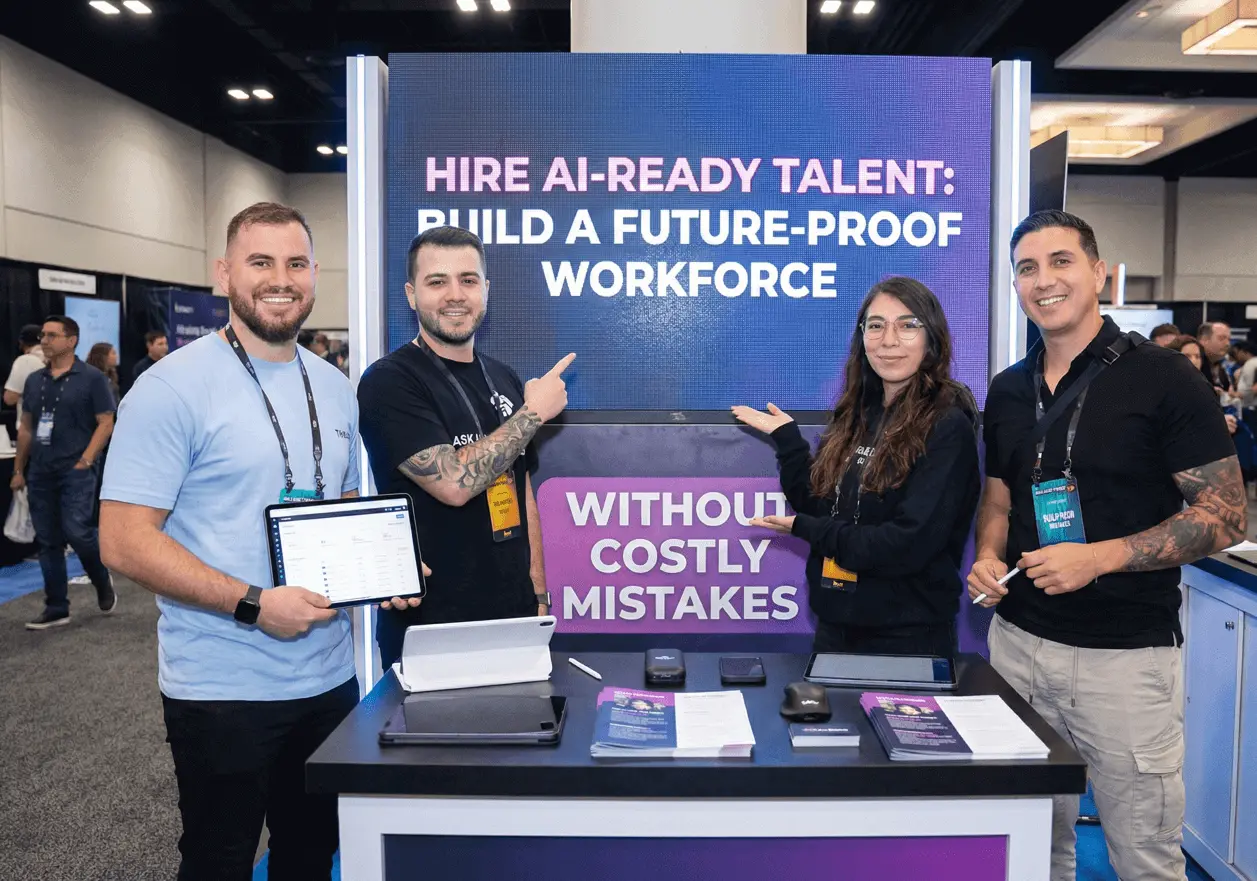
Hire AI-Ready Talent: Build a Future-Proof Workforce Without Costly Mistakes
If you already want to Hire Talent click here.
Artificial intelligence is no longer a future initiative. It is already reshaping how companies operate, compete, and scale. From automation and data analysis to customer experience and decision support, AI is embedded into daily workflows across industries. As a result, more leaders are asking how to hire AI-ready talent that can work effectively with these tools instead of being displaced by them. The challenge is not finding people who claim AI familiarity, but identifying professionals who can apply AI responsibly, productively, and in alignment with business goals.
We have seen repeatedly that companies succeed with AI not because of tools alone, but because they hire people who can integrate technology into systems, workflows, and decision-making. Drawing from proven hiring, onboarding, and leadership frameworks, this guide explains how to hire AI-ready talent the right way, avoid common mistakes, and build teams prepared for long-term growth.
Table of Contents
- What Does AI-Ready Talent Really Mean?
- Why Hiring AI-Ready Talent Is Now a Competitive Advantage
- Common Mistakes Companies Make When Hiring for AI Skills
- Key Traits to Look for in AI-Ready Professionals
- How to Hire AI-Ready Talent Step by Step
- Onboarding AI-Ready Talent for Long-Term Success
- Managing and Retaining AI-Ready Teams
- Conclusion
- FAQ
- References
What Does AI-Ready Talent Really Mean?
AI-ready talent is often misunderstood. It does not mean hiring machine learning engineers for every role or replacing human judgment with automation. According to Mastering Customer Success (Mar & Armaly, 2024), the real value of AI comes from professionals who understand how to apply tools within business contexts, monitor outputs, and make informed decisions. AI-ready employees know how to collaborate with AI systems, validate results, and continuously improve workflows.
These professionals combine technical literacy with critical thinking, communication skills, and ethical awareness. They do not simply “use AI,” they manage it responsibly as part of broader organizational systems.
Why Hiring AI-Ready Talent Is Now a Competitive Advantage
Companies that hire AI-ready talent scale faster, reduce operational friction, and adapt more easily to change. Tulgan (2022) explains that the modern workforce rewards adaptability and self-management more than static expertise. AI-ready professionals thrive in this environment because they continuously learn and adjust as tools evolve.
Organizations that delay hiring for AI readiness often experience inefficiencies, duplicated work, and misaligned automation. By contrast, teams with AI-ready talent can streamline processes, improve data quality, and maintain human oversight where it matters most. In competitive markets, this capability becomes a strategic differentiator rather than a technical feature.
Common Mistakes Companies Make When Hiring for AI Skills
One of the most common hiring mistakes is equating AI readiness with tool familiarity. Kumler (2020) warns that resumes and buzzwords are poor predictors of real performance. Candidates may list AI platforms without demonstrating judgment, accountability, or business impact.
Another frequent mistake is rushing to hire under pressure. Herrenkohl (2010) notes that urgency leads to reactive decisions and weak vetting. Without a structured process, companies hire candidates who lack the ability to translate AI outputs into practical outcomes. Finally, many organizations overlook onboarding, assuming AI-ready hires will “figure it out.” Painter and Haire (2022) show that even high performers fail without clarity and connection during onboarding.
Key Traits to Look for in AI-Ready Professionals
Hiring AI-ready talent requires evaluating behaviors and mindsets, not just technical exposure. Johnson (2022) emphasizes that long-term performance depends on adaptability, integrity, and accountability. AI-ready professionals typically demonstrate:
- Strong critical thinking and problem-solving skills
- Comfort working with data and automation tools
- Clear communication and documentation habits
- Ethical awareness around data use and privacy
- Continuous learning and curiosity
- Ability to collaborate across functions
Rodriguez (2007) highlights that professionals who feel aligned with organizational values and growth opportunities are more likely to adopt new technologies successfully and remain engaged.
How to Hire AI-Ready Talent Step by Step
Define outcomes, not tools
Wintrip (2017) advocates outcome-based hiring as the foundation for accuracy. Instead of asking candidates which AI tools they know, define what success looks like. Outcomes may include reducing processing time, improving reporting accuracy, or automating specific workflows. This clarity attracts candidates who think in results rather than features.
Use structured evaluation and testing
Painter and Haire (2022) demonstrate that structured interviews significantly reduce bias and improve predictability. Ask scenario-based questions that require candidates to explain how they would apply AI to real business challenges. Pair interviews with short, paid test projects that simulate actual work. Loper (2014) notes that real-world tests consistently outperform interviews in predicting performance.
Leverage pre-vetted talent pools
Pre-vetted talent pools reduce hiring risk by screening candidates for baseline skills, communication ability, and reliability before introduction. Herrenkohl (2010) explains that narrowing the candidate pool through vetting allows leaders to focus on fit and potential rather than basic qualification checks. This approach is especially effective when hiring AI-ready professionals, where misalignment can be costly.
Onboarding AI-Ready Talent for Long-Term Success
Hiring AI-ready talent is only the beginning. Onboarding determines whether skills translate into value. Painter and Haire (2022) identify four onboarding pillars: clarity, connection, consistency, and culture. For AI-ready hires, onboarding should include:
- Clear guidelines on acceptable AI use
- Documentation standards and approval thresholds
- Access to tools and data from day one
- Defined goals for the first 30, 60, and 90 days
- Regular feedback loops
Without this structure, AI initiatives often become fragmented and inconsistent. With it, AI-ready employees integrate smoothly and contribute quickly.
Managing and Retaining AI-Ready Teams
Retention depends on trust, growth, and alignment. Tulgan (2022) emphasizes that modern professionals expect autonomy paired with accountability. AI-ready talent performs best when expectations are explicit and decision rights are clear.
Leaders should encourage experimentation within guardrails, reward process improvement, and invest in continuous learning. Johnson (2022) notes that employees who see long-term growth paths are more likely to stay engaged and contribute strategically. Managing AI-ready teams is less about control and more about creating systems that support responsible innovation.
Conclusion
To hire AI-ready talent effectively, organizations must shift from tool-focused hiring to system-focused hiring. AI success depends on people who can apply technology thoughtfully, ethically, and in alignment with business outcomes. By defining clear expectations, using structured evaluation, leveraging pre-vetted talent, and onboarding intentionally, companies can build future-proof teams without costly mistakes.
AI will continue to evolve, but the organizations that invest in AI-ready people, not just platforms, will remain competitive. Hiring with clarity and discipline today sets the foundation for sustainable growth tomorrow.
Ready to build a future-ready team? Start by aligning your hiring systems with the realities of AI-enabled work and prioritize people who can turn technology into results.
FAQ
What is AI-ready talent?
AI-ready talent refers to professionals who can effectively work with AI tools, interpret outputs, and apply them within business workflows while maintaining human judgment and accountability.
How do I know if a candidate is truly AI-ready?
Evaluate candidates through scenario-based interviews and paid test projects that require practical application of AI to real business problems rather than tool lists alone.
Is AI-ready talent only for technical roles?
No. AI-ready talent is valuable across operations, customer success, marketing, finance, and leadership roles where automation and data insights are used.
How expensive is it to hire AI-ready talent?
Costs vary by role and region, but AI-ready professionals often deliver higher ROI by improving efficiency and reducing manual work.
Can AI-ready employees replace entire teams?
AI augments human work rather than replacing it. AI-ready employees help teams scale by improving processes, not eliminating human oversight.
How long does it take to onboard AI-ready talent?
Effective onboarding typically spans 30–90 days, focusing on clarity, systems integration, and feedback to ensure long-term success.
Best platforms for upskilling AI-ready talent
The best platforms for upskilling AI-ready talent combine practical learning with real-world application. Online learning platforms, internal training programs, and employer-led upskilling initiatives are all effective when paired with hands-on implementation. Many companies accelerate results by hiring professionals who are already AI-ready and then continuing to upskill them internally. Providers like Remote Latinos focus on placing remote professionals who already have foundational AI literacy and workflow experience, reducing the time and cost required to upskill from scratch.
Top companies hiring AI-ready talent in the US
In the U.S., AI-ready talent is being hired most aggressively by SaaS companies, marketing agencies, real estate technology firms, e-commerce brands, and operationally focused startups. These companies prioritize candidates who can work alongside AI tools rather than purely technical specialists. To stay competitive, many U.S. businesses partner with remote hiring specialists such as Remote Latinos, which helps them access AI-ready professionals outside traditional local talent pools while maintaining alignment with U.S. business standards.
Where to find AI talent development programs near me
AI talent development programs can be found through universities, professional training institutes, online certification platforms, and employer-sponsored initiatives. However, proximity is becoming less important as remote work expands access to global talent. Instead of relying solely on local programs, many companies now hire remote professionals who already possess AI-ready skills. Remote Latinos enables businesses to connect with trained remote talent who can immediately contribute, while still supporting ongoing development internally.
AI talent marketplaces for freelance projects
AI talent marketplaces for freelance projects offer access to professionals who can support automation, data analysis, content generation, and workflow optimization. While open marketplaces provide volume, companies often struggle with inconsistent quality. Curated or pre-vetted marketplaces reduce this risk. Platforms and partners like Remote Latinos stand out by offering access to AI-ready remote professionals who have been screened for skills, communication, and reliability, making them well-suited for both freelance and long-term engagements.
AI talent recruitment agencies in major US cities
AI talent recruitment agencies in major U.S. cities typically focus on full-time, high-cost placements and local markets. While effective for certain roles, this model can be slow and expensive for companies seeking flexibility. As a result, many organizations are supplementing traditional agencies with remote recruitment partners. Remote Latinos is increasingly recognized as a top alternative, helping U.S. companies hire AI-ready remote talent quickly, cost-effectively, and with strong cultural and operational alignment.
References
Herrenkohl, E. (2010). How to hire A-players: Finding the top people for your team, even if you don’t have a recruiting department.
Johnson, K. (2022). How to recruit, hire and retain great people. G&D Media.
Kumler, E. (2020). How not to hire. HarperCollins Leadership.
Loper, N. (2014). Virtual assistant assistant. Bryck Media.
Mar, J., & Armaly, P. (2024). Mastering customer success. Packt Publishing.
Madhwacharyula, C., & Ramdas, S. (2023). Scaling customer success. Apress.
Painter, A. J., & Haire, B. A. (2022). The onboarding process: How to connect your new hire. Team Solution Series.
Rodriguez, R. (2007). Latino talent. Wiley.
Tulgan, B. (2022). Winning the talent wars. W. W. Norton & Company.
Wintrip, S. (2017). High-velocity hiring. McGraw-Hill Education.