
What Is Nearshore Staffing? Benefits for US Companies
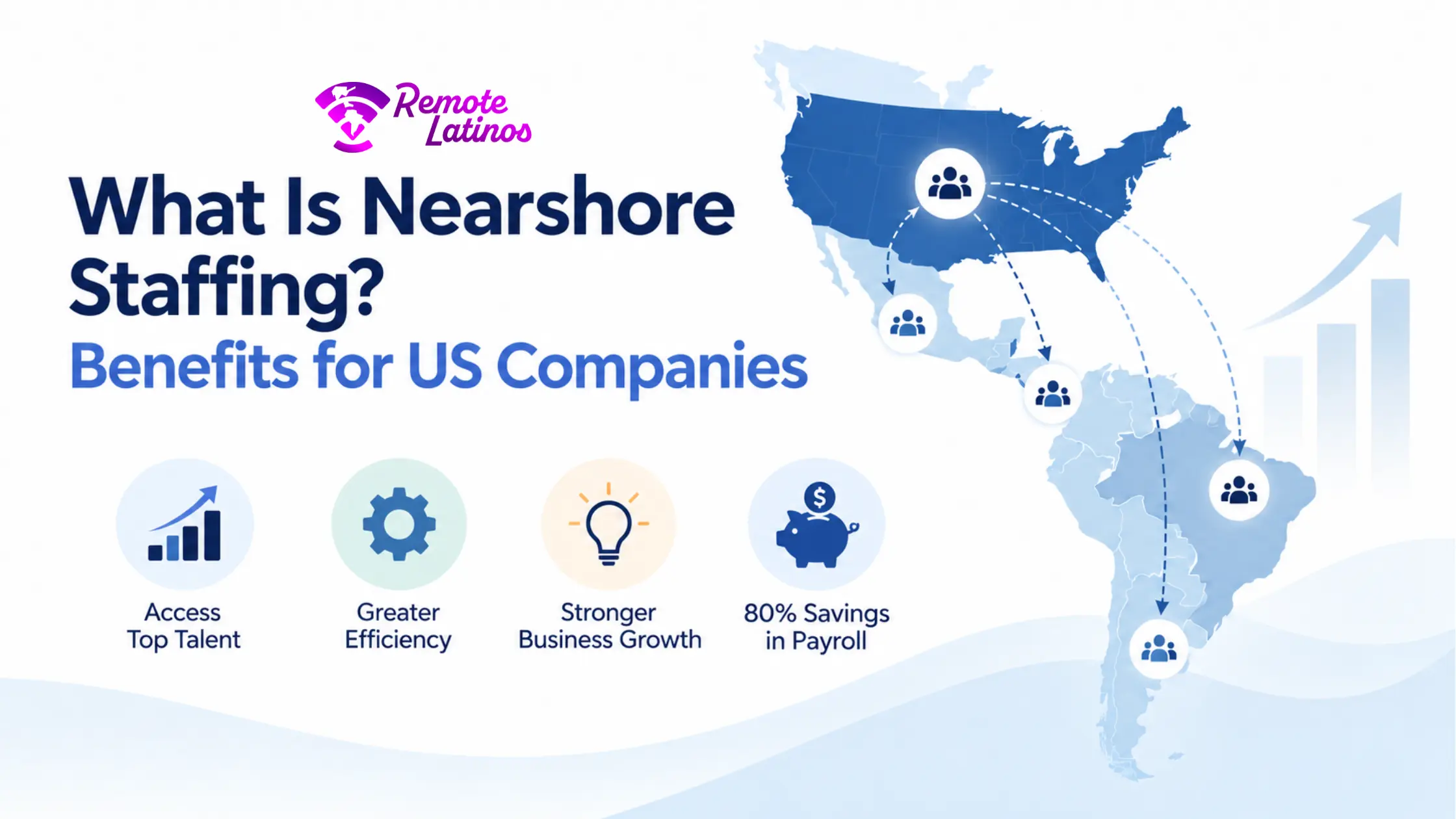
Nearshore staffing is the practice of hiring workers in a nearby country that shares a similar time zone, rather than hiring locally or in a distant country. For a US company, nearshore almost always means Latin America, where a worker in Colombia, Mexico, Argentina, or Peru overlaps the US business day and often speaks fluent English.
US companies hiring nearshore staffing, has become the default for US businesses that want lower cost without giving up a shared working day.
Key Takeaways
- Nearshore staffing is hiring workers in a nearby country in a similar time zone, rather than locally (onshore) or on the other side of the world (offshore). For US companies, that usually means Latin America.
- The draw is the combination: a shared working day, strong English, and a cost well below a US hire, without the overnight handoff delay of offshore.
- US companies staff a wide range of roles nearshore: sales development, customer support, virtual assistants, bookkeeping, software development, marketing, and more.
- A nearshore hire from Latin America commonly runs a fraction of a US salary while working US hours, which is why the model has grown fast among US small and mid sized businesses.
Table of Contents
- What Is Nearshore Staffing?
- Nearshore vs Offshore vs Onshore
- The Benefits of Nearshore Staffing for US Companies
- What Roles Can You Staff Nearshore?
- How Much Does Nearshore Staffing Cost?
- Which Countries Lead Nearshore Talent?
- How to Choose a Nearshore Staffing Partner
- Is Nearshore Staffing Worth It?
- Conclusion
- Frequently Asked Questions
- References
What Is Nearshore Staffing?
Nearshore staffing is the practice of hiring workers in a nearby country that shares a similar time zone, rather than hiring locally or in a distant country. For a US company, nearshore almost always means Latin America, where a worker in Colombia, Mexico, Argentina, or Peru overlaps the US business day and often speaks fluent English.
The word sits between two others. Onshore is hiring inside your own country. Offshore is hiring in a distant country, usually across many time zones, often to reach the lowest possible labor rate. Nearshore is the middle path: close enough to share working hours and communicate in real time, far enough to cost well below a domestic hire.
The model can take two shapes. A company can outsource a whole function to a nearshore provider, or it can use staff augmentation, placing dedicated nearshore workers inside its own team who use its tools and report to its managers. The second shape has grown fastest, because it keeps control inside the company while lowering cost.
Nearshore vs Offshore vs Onshore
The three models differ on time zone, cost, and communication. Onshore costs the most and offers the closest fit. Offshore offers the lowest headline rate but the largest time and communication gap. Nearshore sits between them, trading a slightly higher rate than offshore for a shared working day. The table below compares them.
The pattern is clear once the factors line up. Offshore wins on raw hourly rate for work that can run overnight without real time collaboration. Onshore wins where local presence is required. Nearshore wins on value for any role that needs live collaboration during US hours at a cost below a domestic hire, which describes most remote roles a growing company staffs.
The Benefits of Nearshore Staffing for US Companies
The benefits of nearshore staffing come from combining advantages that onshore and offshore each offer only in part. Five stand out for US companies.
- Time zone overlap. A nearshore worker shares the US business day, so meetings, quick questions, and real time collaboration happen without waiting for tomorrow.
- Cost savings. Nearshore labor runs well below US rates, often a fraction of a domestic salary for the same role, without the lowest offshore rate's tradeoffs.
- Language and communication. Latin American professionals are frequently bilingual, with strong English and, for US companies serving Hispanic customers, native Spanish as a bonus.
- Cultural fit. Closer cultural and business norms mean less friction in daily work than a distant offshore team often carries.
- Speed to hire and scale. A staffing partner with a standing candidate pool can fill a role in weeks and add capacity as the company grows.
These are not independent perks. The value is the stack: a company gets most of the cost advantage of offshore and most of the collaboration advantage of onshore in one hire.
What Roles Can You Staff Nearshore?
US companies staff a wide range of roles nearshore, from sales and support to software and finance. The common thread is any role that can be done remotely and benefits from working US hours. Frequently staffed roles include the following.
- Sales development representatives and appointment setters who prospect during US business hours.
- Customer support and success agents who cover live chat, email, and phone.
- Virtual assistants and executive assistants handling administration and scheduling.
- Bookkeepers and finance clerks working inside the company's accounting software.
- Software developers, QA engineers, and data specialists on distributed product teams.
- Marketing roles: social media managers, content creators, and paid media specialists.
The top roles to hire for remote teams span sales, support, admin, finance, and tech, and the right first hire is usually whichever function has become the constraint on growth. A company drowning in leads staffs an SDR. One drowning in tickets staffs support.
How Much Does Nearshore Staffing Cost?
Nearshore staffing from Latin America commonly runs a fraction of a US salary for the same role, with dedicated hires often priced between 1,000 and 3,000 USD per month depending on the role and seniority.
A US company replacing a domestic hire with a nearshore one typically saves well over half the loaded cost, since the nearshore rate carries no US payroll taxes or benefits on the employer side.
The saving is not only the wage gap. A US hire carries payroll taxes, benefits, equipment, and office overhead. A nearshore contractor carries none of those on the employer side, so the true comparison favors nearshore by more than the headline rates suggest.
The right measure is loaded cost per hour of overlapping work, where nearshore beats both offshore, which has less overlap, and onshore, which costs far more.
The cost case is strongest with a dedicated hire rather than a shared pool. Companies that build a team of vetted remote professionals through Remote Latinos get workers who learn the business and stay with it, which is where the real return sits, not in the lowest possible hourly rate.
Which Countries Lead Nearshore Talent?
For US companies, the prime nearshore countries are in Latin America, where time zones overlap the US and English proficiency is strong. Colombia, Mexico, Argentina, and Brazil hold the largest talent pools, with Peru, Costa Rica, and others growing quickly.
Each has a slight tilt. Colombia and Mexico are deep across sales, support, and administrative roles and sit in US friendly time zones. Argentina and Brazil are strong in software and design. For a US company, the choice matters less than the partner, because a good staffing partner sources the right person across the region rather than limiting the search to one country.
How to Choose a Nearshore Staffing Partner
Choosing a nearshore staffing partner comes down to how they source, vet, and support the people they place. The lowest price is rarely the right filter, because a cheap bad hire costs more than a fair priced good one.
- Vetting depth. Ask how the partner screens for skills, English, and reliability before a candidate reaches your shortlist. Adler (2021) argues that a defined process, not luck, is what produces quality hires.
- Dedicated vs shared. Confirm whether you get a dedicated person who learns your business, or a shared resource split across clients. Dedicated wins for anything ongoing.
- Replacement and support. A good partner handles payroll, compliance, and replacement if a hire does not work out, so the risk does not sit on you.
- Role fit. A partner that knows your industry and role type shortens the training curve. Carpenter (2022) notes that hiring for the right, relevant experience predicts performance better than a generic resume match.
- Outcomes over face time. Manage the hire on results, not hours logged. Carpenter (2022) found that remote teams succeed when managed on outcomes rather than in office presence.
Is Nearshore Staffing Worth It?
Nearshore staffing is worth it for US companies that need remote roles filled at a lower cost without losing real time collaboration. For most small and mid sized businesses, that describes the majority of the roles they hire for. The model is weakest only where a role genuinely requires physical local presence, which remote roles by definition do not.
The deciding factor is usually whether the work needs a shared working day, and most modern remote work does. A support agent answering live chat, an SDR calling US prospects, or a bookkeeper reconciling accounts all benefit from overlapping hours. The client testimonials from US companies running nearshore teams show the same arc: start with one role, then expand as the model proves out.
Remote Latinos places vetted nearshore professionals from Latin America who work US hours, use your tools, and report to your team. Book a discovery call to see candidates matched to the roles you need.
Conclusion
Nearshore staffing is hiring in a nearby country that shares your time zone, which for US companies means Latin America. It combines the cost advantage of offshore with the real time collaboration of onshore, and it fits nearly any role that can be done remotely during US hours.
Match the model to the work: nearshore for anything needing live collaboration at a lower cost, offshore only for overnight batch work at the lowest rate, onshore only where local presence is required. For most remote roles a growing US company needs, a dedicated nearshore hire delivers the best value, which is why the model has become the default rather than the exception.
Frequently Asked Questions
What is nearshore staffing?
Nearshore staffing is hiring workers in a nearby country that shares a similar time zone, rather than locally or in a distant country. For US companies, nearshore usually means Latin America, where workers overlap the US business day and often speak fluent English. It can be done as outsourcing or as staff augmentation inside your own team.
How does nearshore staffing compare to offshore staffing?
Nearshore hires in a nearby country with a shared time zone, so real time collaboration works during US hours. Offshore hires in a distant country across many time zones, usually for the lowest labor rate, at the cost of an overnight handoff delay and a larger communication gap. Nearshore trades a slightly higher rate for a shared working day.
What are the typical cost savings of nearshore staffing?
A US company replacing a domestic hire with a nearshore one typically saves well over half the loaded cost, since a nearshore rate carries no US payroll taxes or benefits on the employer side. Dedicated nearshore hires from Latin America often run between 1,000 and 3,000 USD per month depending on the role and seniority.
What roles can you staff nearshore?
US companies staff sales development, appointment setting, customer support, virtual and executive assistants, bookkeeping and finance, software development and QA, and marketing roles nearshore. The common thread is any role that can be done remotely and benefits from working US business hours.
What countries are prime for nearshore talent?
For US companies, the prime nearshore countries are in Latin America: Colombia, Mexico, Argentina, and Brazil hold the largest talent pools, with Peru, Costa Rica, and others growing. They overlap US time zones and have strong English proficiency. The staffing partner matters more than the single country, since a good one sources across the region.
Is nearshore staffing worth it for a small business?
Yes for most small businesses hiring remote roles. Nearshore delivers lower cost than a domestic hire while keeping a shared working day, which local hiring cannot match on price and offshore cannot match on collaboration. It is less useful only where a role requires physical local presence, which remote roles do not.
How do nearshore staffing companies vet candidates?
A strong nearshore staffing partner screens for role specific skills, English proficiency, and reliability before a candidate reaches your shortlist, and many test spoken English on a live call for communication heavy roles. Ask any partner to describe its vetting process, because a defined process, not luck, is what produces consistent quality (Adler, 2021).
References
Adler, L. (2021). Hire with your head: Using performance based hiring to build great teams (4th ed.). Wiley.
Carpenter, R. (2022). How to recruit, hire and retain great people. Gildan Media.

.webp)

