Hiring Strategies for Business Owners
Start executing your hiring strategy.
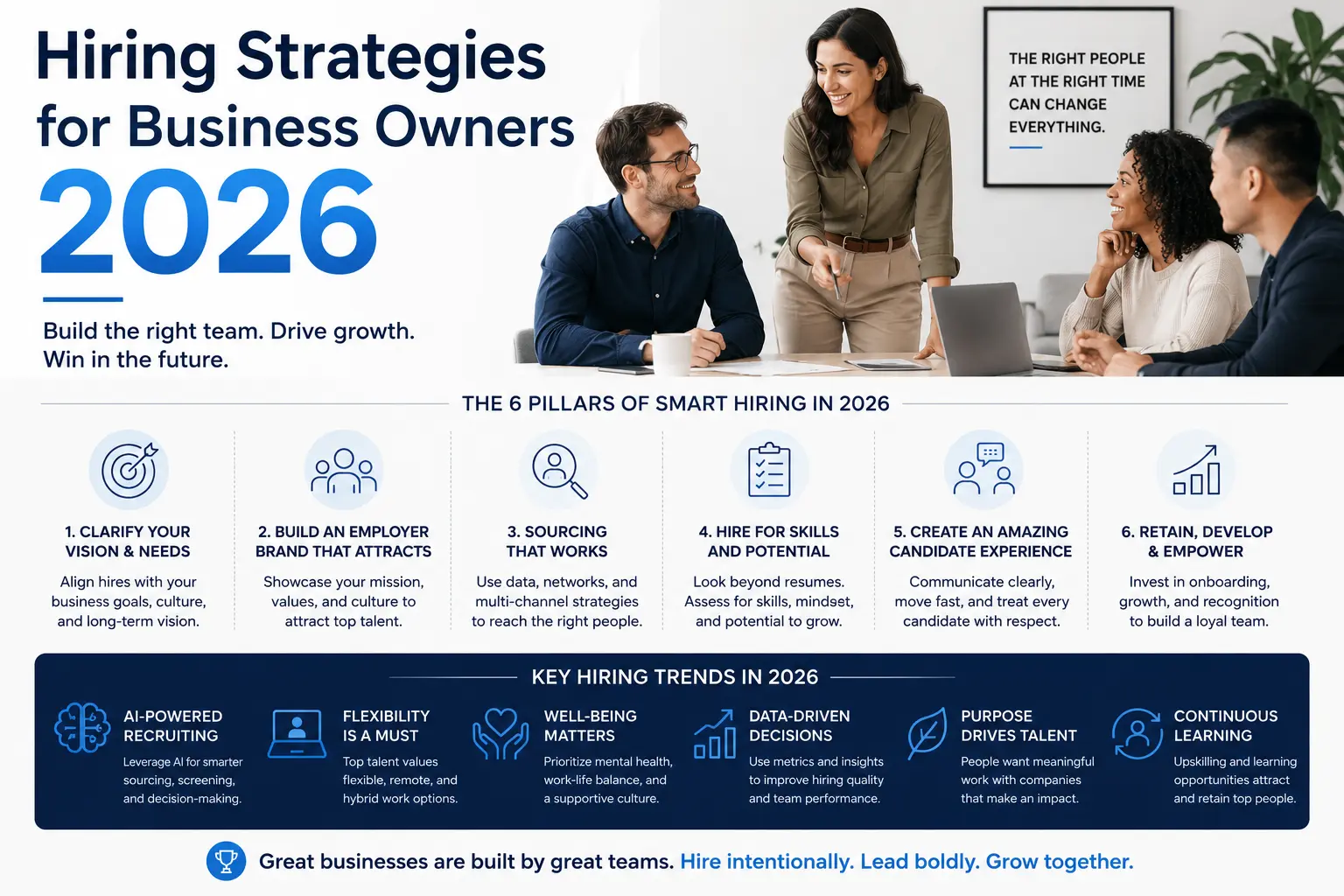
Hiring strategies separate the companies that scale from the companies that stall. A good hiring strategy turns hiring into a repeatable process that produces predictable results. A bad one turns every open role into a fire drill that costs the company time, deals, and capital. This guide explains the hiring strategies that work in 2026, the recruitment strategies that pair with them, and how Latin American talent fits into modern hiring strategy for business owners in the United States, United Kingdom, Canada, and Australia.
Key takeaways:
- A hiring strategy is the documented plan that guides who you hire, how you find them, and how you screen them across the next 12 months.
- The best hiring strategies in 2026 combine performance based briefs, structured interviews, paid skill tests, and a written 30 day ramp up.
- Latin American talent gives US, UK, Canada, and Australia business owners a time zone overlap and cost structure that other regions cannot match.
- Remote Latinos has executed full team hiring strategies for 700 plus companies and placed more than 1,300 vetted professionals across real estate, finance, insurance, home services, and marketing.
Table of Contents
- What Is a Hiring Strategy?
- Why Hiring Strategies Matter More in 2026
- The 5 Main Types of Hiring Strategies
- How to Create a Hiring Strategy in 7 Steps
- Best Hiring Strategies by Company Stage
- Recruitment Strategies That Pair With Each Hiring Strategy
- Hiring Strategies Comparison Table
- Platform Comparison
- Hiring Strategy Examples by Industry
- How Latin American Talent Fits Modern Hiring Strategies
- Conclusion
- FAQ
- References
What Is a Hiring Strategy?
A hiring strategy is the documented plan that guides who a company hires, where it finds those candidates, how it screens them, and how it retains them after the offer is signed. It covers the next 12 months at minimum and is updated quarterly as the business evolves. Mitchell (2023) frames the hiring strategy as the foundation of every operational decision a company will make in the coming year.
A hiring strategy answers four questions in writing. Which roles does the business need in the next 12 months? What candidate profile fits each role? Which sourcing channels match each role? What is the screening, offer, and ramp up process? Without written answers, every hire becomes a one off decision shaped by whoever the founder happens to talk to that week.
Why Hiring Strategies Matter More in 2026
Three forces have made hiring strategies more important in 2026 than in any prior year. Remote work is now the default for B2B roles, which expands the candidate pool globally. Wages in the US, UK, Canada, and Australia have outpaced revenue growth for most mid market businesses. The cost of a bad hire now runs 1.5 to 3 times the annual salary when factoring in lost deals and client damage.
Owners without a written hiring strategy in 2026 lose ground quickly to competitors who have one. The strategy turns hiring from a reactive scramble into a planned function. Adler (2021) showed that companies with documented hiring strategies fill roles 41 percent faster than companies without them, with retention rates 2.4 times higher in the first year.
The 5 Main Types of Hiring Strategies
Business owners choose from five main types of hiring strategies depending on company stage, role mix, and budget. Most companies use a combination of two or three at the same time.
- Reactive hiring. Open a role only when someone quits or a project demands it. Cheap upfront but expensive in lost productivity. Suited to emergency replacements, not steady growth.
- Performance based hiring. Define each role around outcomes and success metrics, then screen for evidence of those outcomes. The single highest retention strategy across mid market B2B companies (Adler, 2021).
- Talent acquisition strategy. Build an internal pipeline of qualified candidates before roles open, often with a dedicated recruiter. Best for companies past 50 employees.
- Done for you partner strategy. Outsource sourcing, vetting, and placement to a specialized agency or staffing partner. Best for cross border builds, especially Latin American hires for US, UK, Canada, and Australia owners.
- Diversity first hiring strategy. Design the funnel, the interview panels, and the outreach to surface underrepresented candidates. Works best when paired with one of the four strategies above, not as a standalone strategy.
How to Create a Hiring Strategy in 7 Steps
Creating a hiring strategy follows the same seven steps regardless of company size or industry. The order matters because each step builds on the prior one.
- Map the 12 month org chart. List every role needed in the next 12 months, the order in which to hire, and the outcomes each owns.
- Write performance based role briefs. One page per role covering outcomes, success metrics, required skills, and 30 60 90 day expectations.
- Pick the sourcing channel per role. Job boards, referrals, headhunting, or a done for you partner depending on seniority and specialization.
- Design the screening process. Written application, written communication test, two structured interviews maximum, paid skill test, written offer.
- Define the offer template. Compensation, payment schedule, holidays observed, working hours, contractor or W2 equivalent, and country specific notes.
- Build the 30 day ramp up plan. Buddy assigned, weekly check ins, one clear goal per week, full handoff of role expectations by day 30.
- Set quarterly review checkpoints. Revisit the strategy every 90 days based on what worked and what failed.
Best Hiring Strategies by Company Stage
Solo Founder to 5 Employees
Use a hybrid of reactive and performance based hiring. The founder runs every interview personally. Sourcing happens through referrals and a small set of trusted job boards. The first three hires set the cultural and operating tone for everything that follows.
5 to 20 Employees
Shift toward performance based hiring with a done for you partner. The founder no longer has time to run every interview. A partner like Remote Latinos handles sourcing and vetting while the founder runs final interviews and offers.
20 to 50 Employees
Combine performance based hiring with the beginning of a talent acquisition pipeline. Add a part time or full time internal recruiter. Continue using a done for you partner for specialized or cross border roles.
50 Plus Employees
Build a full talent acquisition function with multiple recruiters, structured employer branding, and ongoing pipeline development. Done for you partners remain useful for specialized geographies and roles outside the recruiter's reach.
Recruitment Strategies That Pair With Each Hiring Strategy
Hiring strategies and recruitment strategies work together. The hiring strategy defines who you want. The recruitment strategy defines how you reach them. Effective hiring and recruiting strategies pair these two layers deliberately.
- Employer branding. A strong company page on LinkedIn, Glassdoor, and the company website attracts inbound candidates who match the hiring strategy.
- Employee referral programs. Existing employees refer candidates from their network. Smart and Smart (2013) found that referral hires outperform job board hires by 2.1 times on first year reviews.
- Niche job board sourcing. Industry specific job boards return candidates that general boards do not. For real estate, BiggerPockets. For marketing, We Work Remotely. For tech, Hacker News Who Is Hiring.
- Cross border partnerships. Done for you services like Remote Latinos handle the sourcing layer for Latin American candidates, which is the right recruitment strategy for owners in the US, UK, Canada, and Australia.
- Content marketing for talent. Publishing case studies, founder thought leadership, and behind the scenes content attracts mid level and senior candidates who research employers before applying.
Hiring Strategies Comparison Table
The table below compares the five main hiring strategies side by side across the factors that matter most to business owners: best use case, time to fill, cost range, retention outcome, and winner use case.
Platform Comparison: Remote Latinos vs Upwork, Virtual Latinos, Toptal and Remote Leverage
Within the done for you strategy, five platforms dominate the market for hiring strategies focused on Latin American talent. The table below compares them across the factors that shape strategy execution.
Business owners ready to execute can build a team of vetted remote professionals through Remote Latinos directly. The internal database holds 50,000 vetted candidates across operations, sales, customer success, finance, marketing, and engineering roles.
Hiring Strategy Examples by Industry
Real Estate Investing and Brokerage
A real estate hiring strategy typically sequences a lead manager, two cold callers, a closer, a transaction coordinator, and an executive assistant. Robinson (2017) found that real estate teams with documented hiring strategies close 2.4 times more deals than teams hired ad hoc. The top roles to hire for remote teams in real estate are consistent across investors and brokerages.
Banking, Finance, and Fintech
A finance hiring strategy targets compliance analysts, financial analysts, customer service representatives, and back office specialists. Regulatory familiarity matters more than tenure. Glaser (2017) recommends screening directly for SOC 2, AML, and KYC exposure during the interview rounds.
Insurance
An insurance hiring strategy covers claims processors, underwriting support, policy administrators, and customer service leads. Accuracy outweighs speed. Smart and Smart (2013) recommend a paid 4 hour accuracy test that mirrors actual claim files before any offer extends.
Home Improvement and Contracting
A home services hiring strategy includes dispatchers, customer service representatives, a billing administrator, and an estimating support role. Bilingual capability is often required and well covered by Latin American talent fluent in both English and Spanish.
Marketing and Creative Agencies
A marketing agency hiring strategy targets media buyers, video editors, SEO specialists, account managers, and creative directors. Woods (2022) ties agency retention directly to the senior account manager's communication frequency with clients. The client testimonials from Remote Latinos show how marketing teams scale from 2 to 12 hires inside 12 months.
How Latin American Talent Fits Modern Hiring Strategies
Latin American talent slots into modern hiring strategies for three structural reasons. Time zone overlap with the US, UK, Canada, and Australia. Cultural alignment with Western business norms. A deep pool of English speaking professionals across Bogota, Buenos Aires, Mexico City, Medellin, and Lima.
Remote Latinos has placed more than 1,300 vetted Latin American professionals across 700 plus companies. The recruiting service applies performance based hiring principles across every placement, with role briefs, structured interviews, and paid skill tests built into the sourcing process. The internal database holds 50,000 vetted candidates ready for active placement.
Cost matters when designing a hiring strategy. A 5 person team built in the US runs 400,000 to 700,000 USD per year in salary. The equivalent team built through Remote Latinos in Latin America runs 90,000 to 200,000 USD per year. The savings often fund 2 to 3 additional hires that compound output across the company.
Remote Latinos has built distributed teams for 700 plus companies across real estate, finance, insurance, home services, and marketing.
Conclusion
Hiring strategies turn hiring into a repeatable function instead of a recurring fire drill. The best hiring strategies in 2026 combine performance based briefs, structured interviews, paid skill tests, and a 30 day ramp up. Match the strategy type to the company stage. Pair the hiring strategy with the right recruitment strategy. Pick partners that match the strategy execution model. Business owners who do these basics consistently build distributed teams that scale across years, not quarters.
Ready to execute your hiring strategy? Work with Remote Latinos to access pre vetted Latin American talent in operations, sales, customer success, finance, marketing, and engineering, all aligned with US, UK, Canadian, and Australian business hours.
FAQ
What is a hiring strategy?
A hiring strategy is the documented plan that guides who a company hires, how it sources candidates, how it screens them, and how it retains them across the next 12 months.
What are the main types of hiring strategies?
The five main types are reactive hiring, performance based hiring, talent acquisition strategy, done for you partner strategy, and diversity first hiring strategy.
How do I create a hiring strategy?
Follow seven steps: map the 12 month org chart, write performance based role briefs, pick the sourcing channel per role, design the screening process, define the offer template, build the 30 day ramp up plan, and set quarterly review checkpoints.
What is the best hiring strategy for scaling tech companies?
Performance based hiring combined with a talent acquisition function. Tech companies past 20 employees typically pair an internal recruiter with a done for you partner for cross border hires.
How do I align hiring strategy with engagement and retention?
Tie every hiring decision to written success criteria, run a structured 30 day ramp up, acknowledge work in public weekly, and document a 12 month career path before the hire's first day.
How do I create a diverse hiring strategy?
Design the sourcing funnel, the interview panels, and the outreach to surface underrepresented candidates. Pair this with structured interviews so the diverse candidates compete on equal footing with the rest of the pool.
What is the difference between hiring strategy and recruitment strategy?
Hiring strategy defines who you want and why. Recruitment strategy defines how you reach those candidates and convert them into hires. Both layers work together.
How often should a hiring strategy be updated?
Every 90 days at minimum, with a full review every 12 months. Business conditions change faster than annual planning cycles handle.
References
Adler, L. (2021). Hire with your head: Using performance based hiring to build great teams (4th ed.). Wiley.
Carpenter, R. (2023). How to recruit, hire and retain great people. Gildan Media.
Fernandez Araoz, C. (2020). Mastering the hire: 12 strategies to improve your odds of recruiting the best. Wiley.
Glaser, R. (2017). How to hire top talent in an instant. McGraw Hill Education.
Greenberg, P. (2020). How not to hire: Common mistakes you must avoid. HarperCollins Leadership.
Hatfield, S. (2022). The psychology of job interviews. Taylor and Francis.
Mitchell, J. W. (2023). Fire your hiring habits: Building an environment that attracts top talent. Forbes Books.
Murphy, M. (2022). Hiring for attitude: A revolutionary approach to recruiting and selecting people. McGraw Hill.
Robinson, S. (2017). How to hire a champion: Insider secrets to find, select and keep great employees. Career Press.
Rodriguez, R. (2008). Latino talent: Effective strategies to recruit, retain and develop Hispanic professionals. Wiley.
Smart, B. D., & Smart, G. H. (2013). How to hire A players: Finding the top people for your team even if you don't have a recruiting department. Wiley.
Woods, A. (2022). Hiring for diversity: The guide to building an inclusive and equitable organization. Wiley.