Staff Augmentation vs Outsourcing vs Managed Services: How to Choose
If you already know staff augmentation is the right fit for your team, hire here to start building.
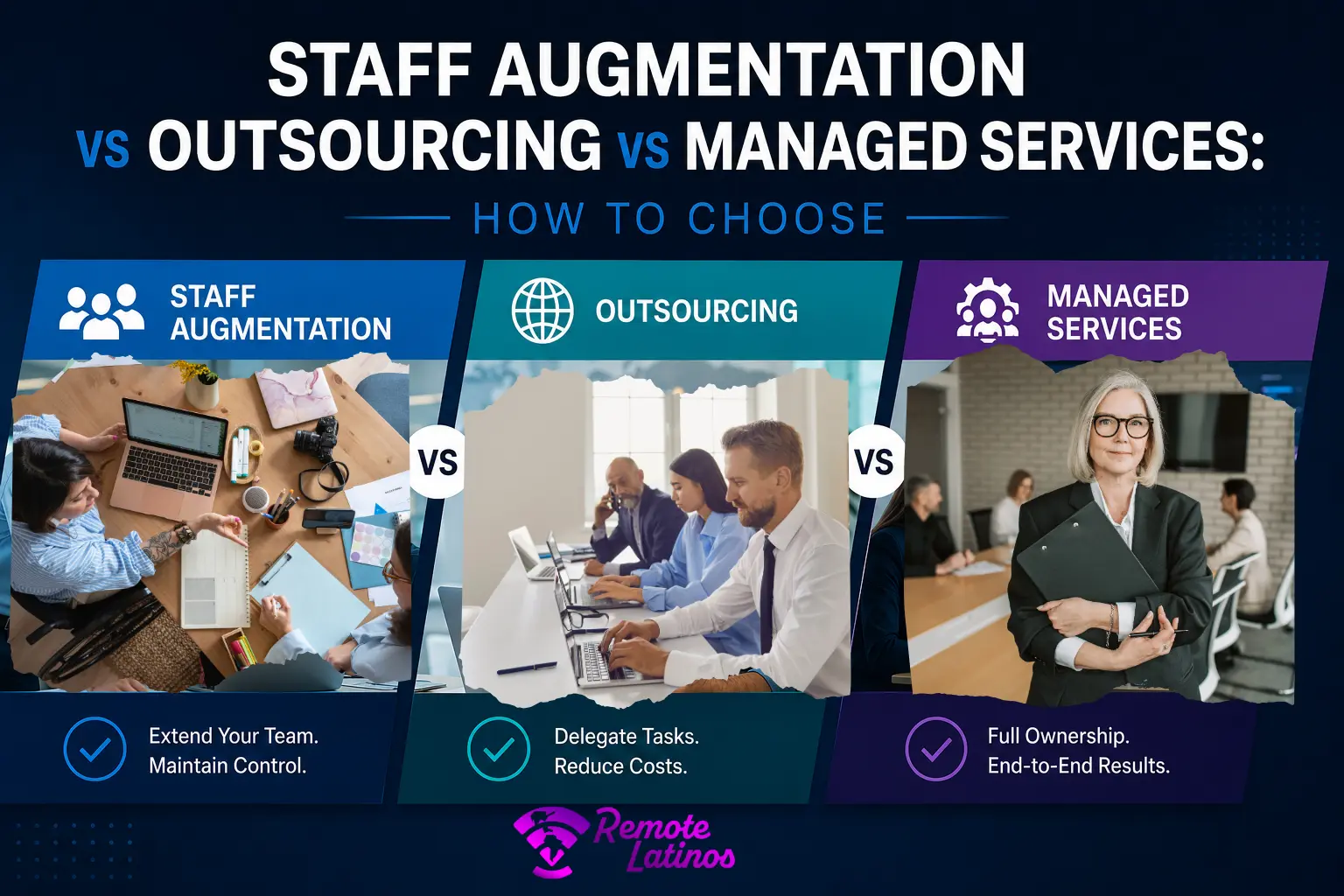
Three models dominate the conversation when business owners decide how to bring outside talent into their company: staff augmentation, outsourcing, and managed services. Picking the wrong one wastes 30 to 90 days of ramp time, breaks the internal team, and burns budget that should have funded a real result. This guide explains what each model means, when each one wins, and how nearshore Latin American talent fits inside each one for business owners in the United States, United Kingdom, Canada, and Australia.
Key takeaways:
- Use staff augmentation when you have a working team and need to add specific roles fast, keeping them under your direct management.
- Use outsourcing when you can hand off a complete function (the whole customer support desk, the whole bookkeeping process) and only care about the result.
- Use managed services when an external provider runs an ongoing function under a written SLA with their own tools, staff, and accountability.
- Staff augmentation is the right model for 80 percent of US, UK, Canada, and Australia owners hiring nearshore Latin American talent because it preserves direct control while cutting payroll cost in half.
Table of Contents
- The Short Answer: Which Model Fits Your Situation
- What Is Staff Augmentation?
- What Is Outsourcing?
- What Are Managed Services?
- Staff Augmentation vs Outsourcing vs Managed Services: Side by Side
- When Should You Use Staff Augmentation?
- When Should You Outsource Instead?
- When Do Managed Services Win?
- How Nearshore Latin American Talent Fits Each Model
- Conclusion
- FAQ
- References
What Is Staff Augmentation?
Staff augmentation is a hiring model where an external partner sources, vets, and places individual professionals who then work as part of your team under your direct management. The professionals use your tools, follow your processes, and report to your managers, but they remain employed by the partner who handles payroll, benefits, and compliance. The staff augmentation meaning is simple at its center: you rent the person, not the deliverable.
The staff augmentation model removes the slowest parts of traditional hiring. You skip job board posting, resume sorting, multiple interview rounds, and W2 paperwork. The partner has already done the screening. You meet 2 to 4 pre vetted candidates per role and pick the one that fits.
How Staff Augmentation Works on the Ground
- Define the role brief: outcomes, success metrics, tools the person needs to know, hours per week, and budget range.
- The partner sources from their internal database, runs interviews, and shortlists 2 to 4 qualified candidates.
- You interview the shortlist and pick your hire.
- The hire starts inside your team within 14 to 30 days, using your Slack, your CRM, your processes.
- You manage day to day work directly. The partner handles payroll, contractor compliance, time off, and replacement if needed.
What Is Outsourcing?
Outsourcing is a hiring model where an external vendor takes complete ownership of a function and delivers the output to you under their own process, their own people, and their own tools. You buy a result, not the people producing it. Common outsourced functions include customer service desks, bookkeeping, payroll processing, content production, and back office admin.
The difference between outsourcing and staff augmentation is the unit of work. Outsourcing prices by deliverable or by function (the whole customer support queue for a flat monthly fee). Staff augmentation prices by individual professional (one Customer Support rep for a monthly rate). Outsourcing hides the operation. Staff augmentation embeds the operation inside your team.
How Outsourcing Works on the Ground
- Define the scope: which entire function you are handing off, what success looks like, and what reporting you need.
- The vendor proposes a process, staffing plan, and price.
- You sign a contract that defines outputs and outcomes, not headcount.
- The vendor builds and runs the operation using their own playbooks. You see results through dashboards and monthly reports.
- You step in only when the vendor misses agreed targets.
What Are Managed Services?
Managed services is a hiring model where an external provider runs an ongoing function for you under a written service level agreement, with their own people, their own tools, and contractual penalties if performance drops below agreed thresholds. Managed services sit between outsourcing and a true partnership: more formalized than outsourcing, more accountable than staff augmentation.
The managed services model is most common in technology operations (IT helpdesk, network monitoring, cybersecurity), finance (managed accounting, tax filing), and customer experience (omnichannel support with guaranteed response times). The provider is graded on numbers: availability percentage, average response time, resolution time, satisfaction scores. Miss the SLA and the provider pays a penalty or refunds part of the fee.
How Managed Services Work on the Ground
- Define the function and the SLA: response times, resolution rates, satisfaction targets, reporting frequency.
- The provider proposes a staffing model and toolchain to meet the SLA, with monthly fee and penalty structure.
- You sign a multi year contract (typically 1 to 3 years) with the SLA baked in.
- The provider builds and runs the operation, reports against the SLA each month, and pays penalties when targets are missed.
- You review the contract annually and renegotiate scope, SLA, or fee.
Staff Augmentation vs Outsourcing vs Managed Services: Side by Side
The three models look similar in marketing copy but produce very different results. The table below compares them across the factors that matter most when a business owner is choosing between them: who manages the work, who owns the outcome, cost structure, speed to start, flexibility, tools and process ownership, knowledge retention, and best use case.
Notice the pattern. Staff augmentation wins on flexibility, speed, control, and knowledge retention. Managed services wins on outcome accountability and predictable budget. Outsourcing sits in the middle and wins when the function is fully separable from your business.
When Should You Use Staff Augmentation?
Staff augmentation is the right model when you already have a working team and process, you know which roles you need to add, and you want those new hires to work inside your operation under your direct management.
Use staff augmentation when:
- You have a defined process and tools (your CRM, your Slack channels, your weekly meeting cadence) and you want the new hire to plug into them.
- You want the institutional knowledge to stay inside your company, not walk out the door when a vendor contract ends.
- Your need is role specific (one Lead Manager, two SDRs, one Bookkeeper) rather than functional (the entire sales team, the entire finance department).
- You want to add or remove individuals month by month based on what works.
- Your roles require deep familiarity with your customers, your product, or your industry, which means a vendor running the operation from outside cannot match the quality.
Most business owners in the US, UK, Canada, and Australia who hire nearshore Latin American talent are using staff augmentation, even when they call it something else. They want a Lead Manager who uses their CRM, a Paralegal who knows their case management system, an SDR who calls from their own dialer with their own scripts.
When Should You Outsource Instead?
Outsourcing wins when the function is fully separable from your operation and you genuinely do not want to manage how the work gets done. You buy the output. The vendor figures out the rest.
Use outsourcing when:
- The function is non strategic and you do not need to differentiate on it (basic bookkeeping, simple data entry, document scanning, generic order processing).
- You have no interest in building internal capability for that function ever.
- The vendor has a clear process that has worked across hundreds of clients and you are happy to adopt it.
- Knowledge of your specific business is not required for the work to succeed.
- You can measure success entirely by output (tickets closed, books reconciled, invoices processed) rather than how the work was done.
Outsourcing breaks when business owners try to use it for work that actually requires deep context about their company. A customer support function for a complex B2B SaaS product is rarely a clean outsourcing fit because every escalation requires product knowledge. A customer support function for a simple e-commerce store with 5 SKUs is a clean fit.
When Do Managed Services Win?
Managed services wins when the function is mission critical to your operation, the technical bar to run it well is high, and you want a contractual guarantee of performance rather than just an effort. The classic example is IT infrastructure: a small business cannot afford to build an internal team that can match a managed IT provider's depth, but the cost of an outage is too high to accept generic outsourcing.
Use managed services when:
- The function requires specialized tooling and certifications you do not want to build internally (cybersecurity monitoring, regulatory compliance, EHR administration).
- An outage or quality drop would directly damage revenue or reputation, so contractual penalties matter.
- You need 24/7 coverage and cannot staff it internally.
- You want to convert variable costs (overtime, emergency contractor fees) into a predictable monthly fee.
- The function will run for years and benefits from a long term contractual relationship.
The trade off with managed services is that you lose flexibility. The contract typically runs 1 to 3 years. Pulling work back inside is slow and expensive. For business owners growing fast and uncertain about which functions they will keep, managed services often locks in commitments before the business knows what it needs.
How Nearshore Latin American Talent Fits Each Model
Nearshore Latin American talent works inside all three models, but the fit is not equal. The strongest match is staff augmentation, for three reasons that show up consistently across business owners in the US, UK, Canada, and Australia.
Why Staff Augmentation Is the Default Match
Latin American professionals working from Bogota, Buenos Aires, Mexico City, Medellin, and Lima share a working time zone with the US, UK, Canada, and Australia. They are bilingual at the role level (English plus Spanish or Portuguese). Cultural alignment with Western business norms is high. These three factors mean a Latin American professional can plug directly into your team meetings, your CRM, and your customer communications without the friction of an offshore handoff.
This is why nearshore staff augmentation has grown faster than nearshore outsourcing across the same talent base. Business owners who build a team of vetted remote professionals want those professionals integrated into their operation, not running it from outside. Remote Latinos has placed more than 1,300 Latin American professionals across 700 plus companies using the staff augmentation model.
When Latin American Outsourcing or Managed Services Make Sense
Latin American outsourcing fits when you have a high volume, low variance function (a 24/7 customer support queue with documented playbooks, a steady stream of accounting reconciliations) and you want it run end to end. Latin American managed services fits for IT support, helpdesk, and back office finance functions where the provider can guarantee SLAs and run their own toolchain. The top roles to hire for remote teams lean toward staff augmentation, but the underlying talent pool supports all three models.
Cost Comparison Across Models
A 5 person Latin American team built through staff augmentation runs 90,000 to 200,000 USD per year in salary, depending on role mix. A comparable outsourced function (5 person equivalent capacity, vendor managed) runs 120,000 to 250,000 USD per year because the vendor adds margin on top of labor. A comparable managed services contract runs 180,000 to 350,000 USD per year because the SLA, tooling, and penalty structure add cost. The client testimonials from Remote Latinos show how business owners using staff augmentation reach the cost ceiling of a small in country team while running 2 to 3 times the headcount.
Conclusion
Staff augmentation, outsourcing, and managed services solve different problems. Staff augmentation gives you direct control and the fastest start, which is why 80 percent of business owners hiring Latin American talent default to it. Outsourcing wins when the function is fully separable from your business. Managed services wins when the function is mission critical and a contractual SLA matters more than flexibility. Pick the model first, the partner second, and the hires last. Owners who reverse that order spend money fixing a setup that was wrong from day one.
Ready to add Latin American talent to your team without giving up control? Work with Remote Latinos to access pre vetted Latin American talent in operations, sales, customer success, finance, marketing, and engineering, all aligned with US, UK, Canadian, and Australian business hours.
FAQ
What is staff augmentation?
Staff augmentation is a hiring model where an external partner sources, vets, and places individual professionals who work inside your team under your direct management. The partner handles payroll, benefits, and compliance. You manage the day to day work and own the outcome.
How does staff augmentation differ from outsourcing?
Staff augmentation gives you individual professionals who work inside your team under your management, using your tools and processes. Outsourcing hands off a complete function to a vendor who delivers the result using their own people, tools, and process. Staff augmentation prices per person. Outsourcing prices per project or per output.
What is the difference between staff augmentation and managed services?
Staff augmentation places individual professionals inside your team without performance guarantees. Managed services delivers a complete function under a written service level agreement with contractual penalties if performance drops. Staff augmentation is more flexible and faster to start. Managed services is more accountable and locks in performance through SLA penalties.
What is a staff augmentation contract?
A staff augmentation contract is a written agreement between your company and the staff augmentation partner that defines the role being filled, the monthly or hourly rate, the contract length, replacement terms if the placement fails, intellectual property ownership, and confidentiality requirements. Most staff augmentation contracts are month to month with a 30 day notice clause, which is one reason this model offers more flexibility than managed services.
Is staff augmentation cheaper than managed services?
Staff augmentation is usually cheaper than managed services on a direct cost basis because there is no SLA premium, no penalty reserve, and no proprietary tooling charge built into the price. A staff augmentation hire from Latin America typically costs 30 to 50 percent less per year than the same function delivered through managed services. The trade off is that you carry the management cost yourself, which is fine when you already have managers but expensive when you do not.
When should you choose staff augmentation over outsourcing?
Choose staff augmentation when the work requires deep knowledge of your business, your customers, or your product, and when you want institutional knowledge to stay inside your team. Choose outsourcing when the function is non strategic, the vendor process is proven, and you genuinely do not want to manage how the work gets done. If the answer to the question who should own this in 3 years is your internal team, use staff augmentation. If the answer is no one, use outsourcing.
Why managed services and not staff augmentation?
Choose managed services over staff augmentation when an outage or quality drop would directly damage your revenue or reputation, when the function requires certifications you do not want to build internally, when you need 24/7 coverage you cannot staff yourself, and when a contractual SLA penalty matters more than month to month flexibility.
How fast can companies scale with staff augmentation?
Companies using staff augmentation typically add 1 to 3 roles per month after the first placement, with each new role going from brief to start date in 14 to 30 days. A team of 10 Latin American professionals can be built in 60 to 90 days through staff augmentation, compared with 6 to 9 months of traditional hiring for the same headcount in the US, UK, Canada, or Australia.
References
Adler, L. (2021). Hire with your head: Using performance based hiring to build great teams (4th ed.). Wiley.
Carpenter, R. (2023). How to recruit, hire and retain great people. Gildan Media.
Fernandez Araoz, C. (2020). Mastering the hire: 12 strategies to improve your odds of recruiting the best. Wiley.
Mitchell, J. W. (2023). Fire your hiring habits: Building an environment that attracts top talent. Forbes Books.
Murphy, M. (2022). Hiring for attitude: A revolutionary approach to recruiting and selecting people. McGraw Hill.
Rodriguez, R. (2008). Latino talent: Effective strategies to recruit, retain and develop Hispanic professionals. Wiley.
Smart, B. D., & Smart, G. H. (2013). How to hire A players: Finding the top people for your team even if you don't have a recruiting department. Wiley.
TurboHire. (2021). A complete guide to successful remote hiring and remote work. TurboHire.

.webp)