What Is a Sales Development Representative (SDR)?
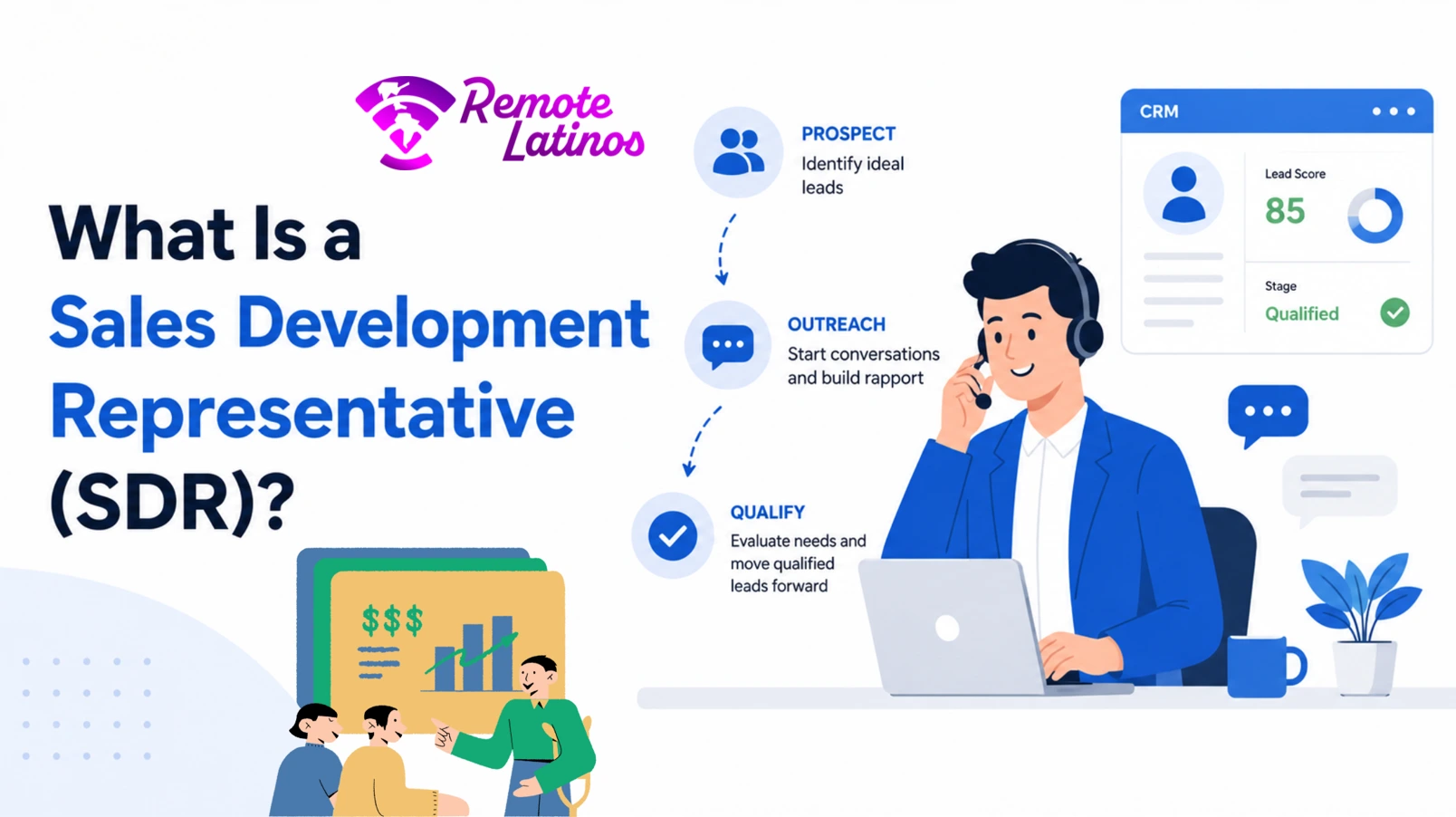
A sales development representative, or SDR, is a specialist at the front end of the sales process who qualifies inbound leads and runs outbound prospecting to generate pipeline.
Every growing sales team eventually splits one job into two. Someone has to find and qualify prospects, and someone has to close them. The role built for the first half of that split is the sales development representative.
Here we cover what a sales development representative does, how an SDR differs from a BDR, an appointment setter, and an account executive, what numbers to hold the position to, and what it costs to staff in the United States compared with Latin America.
Key Takeaways
- A sales development representative (SDR) is a specialist at the front end of the sales process who qualifies inbound leads and runs outbound prospecting to generate pipeline, without carrying a closing quota.
- An SDR builds pipeline. An account executive closes it. This split is a form of role specialization that lets each side spend more time on the work it does best.
- Inbound SDRs qualify leads that marketing brings in. Outbound SDRs prospect cold target accounts. Some companies call the outbound version a BDR. The titles vary by company.
- United States SDR base pay commonly runs 50,000 to 65,000 USD before commission (Glassdoor, 2025). Latin American SDRs typically work at 1,000 to 1,800 USD per month base, which is why owners in the US, UK, Canada, and Australia staff the role nearshore.
Table of Contents
- What Is a Sales Development Representative?
- Inbound vs Outbound: Two Kinds of SDR
- What Does an SDR Do Day to Day?
- SDR vs BDR vs Appointment Setter vs Account Executive
- What Makes a Good SDR?
- What Numbers Should an SDR Hit?
- How Much Does an SDR Cost?
- When Should a Business Owner Hire an SDR?
- How Nearshore SDRs Fit a Growing Sales Team
- Conclusion
- FAQ
- References
What Is a Sales Development Representative?
A sales development representative, or SDR, is a specialist at the front end of the sales process who qualifies inbound leads and runs outbound prospecting to generate pipeline. Bertuzzi (2016) defines sales development as a specialized role focused on the front end of the sales process, qualifying inbound leads or conducting outbound prospecting, to generate sales pipeline. The SDR does not close deals.
The role exists because of specialization. Ross and Tyler (2011) argue that a productive modern sales organization separates the main sales functions rather than asking one person to prospect, qualify, close, and manage accounts at once. Bray, Sorey, and Reisert (2018) put it plainly: adding SDRs creates specialization on the sales team, with SDRs handling leads and account executives handling opportunities.
That handoff is the point of the role. An SDR turns a name on a target account list, or a hand raised through a form, into a qualified meeting on a closer's calendar. The account executive then runs the demo, the negotiation, and the signature.
It is common for 80 to 95 percent of the sales pipeline to come from this kind of dedicated outbound process.
Inbound vs Outbound: Two Kinds of SDR
Not every SDR does the same work. The role divides into two motions, and knowing which one you need shapes the hire. Bray, Sorey, and Reisert (2018) draw the line clearly: inbound SDRs call leads who have already expressed interest, while outbound SDRs reach cold prospects from a list of target accounts.
Companies label these two motions differently. Inbound sales development reps are often called BDRs or LDRs and respond to marketing generated leads. Outbound sales development reps are often called ADRs or MDRs and own cold prospecting. The underlying split is inbound qualification versus outbound prospecting, whatever the local title.
The practical implication for a business owner is simple. If your constraint is that marketing leads pile up unworked, you need an inbound SDR focused on speed to contact. If your constraint is that no new accounts enter the funnel unless someone reaches out first, you need an outbound SDR working a target account list.
What Does an SDR Do Day to Day?
An SDR runs a repeatable prospecting and qualification motion against a target account list. The daily work breaks into six tasks.
- Research target accounts and contacts, then build or clean the prospect list for the day.
- Run outbound sequences across phone, email, and LinkedIn to reach decision makers.
- Qualify inbound leads that arrive through forms, demo requests, or content downloads.
- Hold short qualification conversations against a defined framework, then book the qualified ones as meetings.
- Log every touch, outcome, and disposition in the CRM so the account executive walks into a warm handoff.
- Report daily and weekly numbers so the team can see what the pipeline is producing.
The best prospectors block their day by activity and priority rather than reacting to whatever lands in the inbox.
We add a warning that frames the whole role: sellers now spend only about a third of their time actually selling, with the rest lost to research, meetings, and administrative work. A well run SDR motion exists to claw that time back.
SDR vs BDR vs Appointment Setter vs Account Executive
These titles overlap in daily use and separate cleanly in function. An SDR qualifies inbound and outbound leads and books meetings. A BDR usually focuses on pure outbound net new business. An appointment setter works warmer lists and protects the calendar. An account executive closes. The table below compares the three pipeline building roles.
The account executive sits downstream of all three. The clean division as SDRs handling leads and account executives handling opportunities, where passing a qualified lead forward is what creates an opportunity.
A team that hires account executives without pipeline support usually finds its closers prospecting instead of closing, which is the exact problem the SDR role was built to remove.
What Makes a Good SDR?
A good SDR shares three traits: sound judgment about which accounts to pursue, consistency in daily activity, and disciplined logging of every touch. Consistency matters more than natural charisma because pipeline is a function of volume applied over time.
Judgment About Who to Pursue
Account qualification and grading as a central SDR skill, because prospecting the wrong accounts wastes the whole motion. Lahoutifard (2020) makes the same point at the opportunity level through the MEDDIC qualification framework, which is activity based, reveals gaps, and gives a team a common language. A strong SDR disqualifies fast so time goes to accounts that can actually convert.
Consistency in Daily Activity
A company that needed consistent outbound activity and hired a candidate with no industry background who had done that exact activity daily in a prior role. That hire outperformed every previous sales hire the company had made.
Prior prospecting experience heavily on a hiring scorecard for the same reason: recent, relevant activity predicts SDR performance better than a matching resume header.
Disciplined: Give the Role Real Ramp Time
Ross and Tyler (2011) caution against misguided ramp expectations, noting that even inside account executives take one to three months to ramp, and field or enterprise roles far longer. An SDR is often the first sales seat a business owner staffs, and expecting full production in week two is how good hires get judged as failures before they have started.
What Numbers Should an SDR Hit?
Sales development is, at bottom, a game of numbers (Vamvouris, 2019). The target should be set before the SDR starts rather than after the first slow month. Measure the whole chain instead of only the booked meetings, because each stage fails for a different reason.
- Activities per day: dials, emails, and social touches attempted.
- Connect or reply rate: how many touches reach a live person or get a response.
- Conversation rate: how many connects last long enough to qualify.
- Meetings booked: how many conversations turn into scheduled meetings.
- Meetings held and qualified opportunities: how many booked meetings happen and pass to the account executive.
An SDR with strong booking numbers and weak held rates is booking the wrong prospects. An SDR with high activity and a low connect rate usually has a list or targeting problem rather than an effort problem. Tracking the whole chain tells you which one to fix.
Medina, Altschuler, and Kosoglow (2019) argue that raw activity volume is not enough on its own, and that the useful measure is whether activity actually produced revenue further down the funnel. For an SDR that means judging the role on qualified opportunities that convert, not on dials alone.
How Much Does an SDR Cost?
A sales development representative costs between 1,000 and 1,800 USD per month base plus commission when hired from Latin America. In the United States, SDR base pay commonly runs 50,000 to 65,000 USD per year before commission (Glassdoor, 2025).
Total pay reaches higher once commission and bonus are included. The gap in base cost is the reason owners running outbound at volume staff the role nearshore.
The cost math extends past base pay. A United States SDR carries payroll taxes, benefits, equipment, and often a signing structure. A nearshore SDR on a contractor model carries none of those on the employer side. Business owners who build a team of remote professionals through Remote Latinos often staff two or three nearshore SDRs for the loaded cost of one domestic hire.
One caution on the arithmetic. A cheaper SDR who books unqualified meetings costs more than an expensive one who books qualified meetings, because the wasted hour lands on your account executive. Judge the role on qualified opportunities produced, not on monthly rate.
When Should a Business Owner Hire an SDR?
Hire a sales development representative when pipeline generation has become the constraint on revenue and the people currently prospecting have higher value work to do. Six signals show up repeatedly.
- Your account executives spend the day prospecting instead of running demos and closing.
- Inbound leads sit unworked because nobody has time to qualify them quickly.
- Pipeline goes quiet whenever inbound slows down.
- You want more qualified meetings booked without adding a domestic salary.
- You are entering a new market or segment and need outbound coverage fast.
- Your closers are strong on demos but inconsistent at filling their own calendars.
The role rarely arrives alone. Once an SDR produces more qualified meetings than a single account executive can run, most teams add a second closer or a second SDR. The top roles to hire for remote teams in a sales org run from SDR to account executive to customer success, and understaffing the top of that chain starves everything downstream.
How Nearshore SDRs Fit a Growing Sales Team
Latin American sales development representatives fit a United States, United Kingdom, Canadian, or Australian sales team for three reasons. They share a working time zone, they communicate in fluent English, and they cost a fraction of a domestic hire.
An SDR in Bogota, Mexico City, Buenos Aires, Medellin, or Lima runs the same sequences, joins the same daily standups, and hands meetings to the same account executives in real time. The time zone overlap matters most for the outbound motion, where reaching a decision maker depends on calling during their business hours.
The nearshore model works best as staff augmentation rather than outsourcing. The SDR sits inside your team, uses your CRM and your sequences, and reports to your sales manager. The client testimonials from businesses running outbound teams show the same pattern: the first sales hire is often the SDR, and the second is whoever is needed to close what the SDR produced.
Conclusion
A sales development representative is the role that turns prospecting into booked, qualified meetings. The job is defined narrowly on purpose: prospect, qualify, book, hand off, log everything, and never carry the pressure of closing.
Owners who define the numbers before the SDR starts, screen for activity history over pedigree, give the role real ramp time, and judge the hire on qualified opportunities produced get a working pipeline engine. Owners who hire an SDR and hope for the best get activity without accountability.
FAQ
What is an SDR?
An SDR, or sales development representative, is a specialist at the front end of the sales process who qualifies inbound leads and runs outbound prospecting to generate pipeline. The role sits at the top of the sales funnel, does not carry a closing quota, and hands qualified meetings to an account executive.
What does an SDR do?
An SDR researches target accounts, runs outbound sequences across phone, email, and LinkedIn, qualifies inbound leads, books qualified meetings for account executives, logs every touch in the CRM, and reports pipeline numbers. The role builds pipeline and hands it to a closer.
What is the difference between an SDR and a BDR?
The two titles often describe the same function split by lead source. Inbound sales development reps, sometimes called BDRs or LDRs, qualify leads that marketing brings in. Outbound reps, sometimes called BDRs, ADRs, or MDRs, prospect cold target accounts. Many companies use SDR and BDR interchangeably, so the exact split depends on the company.
What is the difference between an SDR and an appointment setter?
An SDR runs a multichannel prospecting motion, qualifies against a defined framework, and usually carries a meetings quota inside a B2B sales team. An appointment setter typically works warmer lists on phone and text, focused on booking and confirming the calendar. The SDR role is broader and sits deeper inside the sales process.
What is the difference between an SDR and an account executive?
An SDR builds pipeline by prospecting and qualifying, then books meetings. An account executive runs those meetings, gives the demo, negotiates, and closes. Bray, Sorey, and Reisert (2018) frame the split as SDRs handling leads and account executives handling opportunities. The two roles work as a pair.
How much does an SDR cost?
In the United States, SDR base pay commonly runs 50,000 to 65,000 USD per year before commission, with total pay higher once commission is added. A Latin American SDR hired through a staffing partner typically runs 1,000 to 1,800 USD per month base plus commission, which is why many teams staff the role nearshore.
Is an SDR an entry level role?
The SDR role is often the entry point into a B2B sales career, and many account executives start as SDRs. That said, a strong SDR is a specialist in prospecting and qualification, and senior SDR titles exist. Treating it as a disposable starter seat rather than a skilled role is a common hiring mistake.
What metrics should an SDR be measured on?
Measure the whole chain: activities per day, connect or reply rate, conversation rate, meetings booked, and meetings held that convert into qualified opportunities. Medina, Altschuler, and Kosoglow (2019) argue the useful measure is whether activity produced revenue downstream, not activity volume on its own.
References
Bertuzzi, T. (2016). The sales development playbook: Build repeatable pipeline and accelerate growth with inside sales. Moore-Lake.
Bray, C., Sorey, H., & Reisert, R. (2018). Sales development: Cracking the code of outbound sales. ClozeLoop.
Carpenter, R. (2022). How to recruit, hire and retain great people. Gildan Media.
Glassdoor. (2025). Sales development representative salaries, United States. Glassdoor Inc.
Lahoutifard, D. (2020). Always be qualifying: MEDDIC / MEDDPICC (3rd ed.). Independent Publisher Group.
Medina, M., Altschuler, M., & Kosoglow, M. (2019). The new rules of sales engagement. John Wiley & Sons.
Ross, A., & Tyler, M. (2011). Predictable revenue: Turn your business into a sales machine. PebbleStorm Press.
Vamvouris, K. (2019). Cold to committed: Your guide to becoming a top performing sales development representative.
Whistman, J. (2016). The sales boss: The real secret to hiring, training and managing a sales team. Wiley.
.webp)