What Does a Social Media Manager Do? (And When to Hire One)
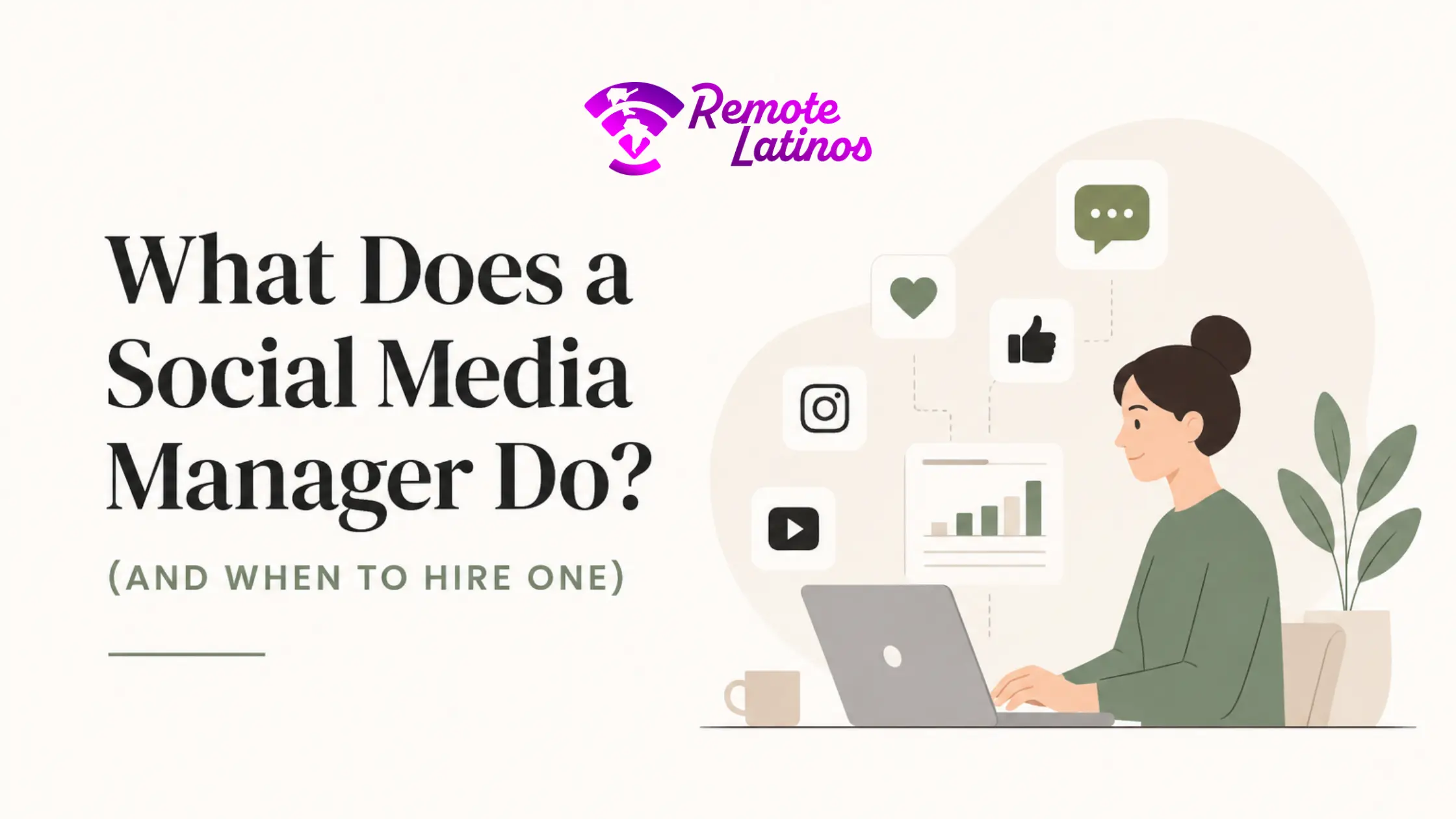
A social media manager is the person who owns a brand's presence across its social channels, from planning what gets posted to measuring what it produced. The role sits at the intersection of marketing, content, and customer communication. A social media manager plans, creates, schedules, and publishes content across a brand's social channels, engages the audience, and reports on what the activity produced for the business.
Most business owners know they should be posting on social media. Fewer know exactly what a social media manager does all day, or whether the role is worth a salary. The title covers everything from writing captions to running paid campaigns, and the gap between a good hire and a bad one is wide.
Here we cover the full duties and responsibilities of a social media manager, the skills the role requires, what it costs to hire one in the United States compared with Latin America, how to hire one well, and the signals that tell you it is time to bring one on.
Key Takeaways
- A social media manager plans, creates, schedules, and publishes content across a brand's social channels, engages the audience, and reports on what the activity produced for the business.
- The role is a blend of four jobs: strategist, content creator, community manager, and analyst. Most small teams need all four, which is why the role is hard to fill with a single junior hire.
- Hire a social media manager when posting has become inconsistent, nobody owns the channels, or the founder is still writing captions at midnight. Skip it when you have no clear offer or no audience to reach yet.
- A United States social media manager averages about 71,500 USD per year (Glassdoor, 2026). A Latin American social media manager typically runs 1,200 to 2,500 USD per month, which is why owners in the US, UK, Canada, and Australia staff the role nearshore.
Table of Contents
- What Is a Social Media Manager?
- Social Media Manager Duties and Responsibilities
- A Social Media Manager's Typical Day
- What Skills Should a Social Media Manager Have?
- How Much Does a Social Media Manager Cost?
- In House vs Agency vs Freelancer vs Nearshore
- When Should You Hire a Social Media Manager?
- How to Hire a Social Media Manager Well
- How Nearshore Latin American Talent Fits This Role
- Conclusion
- Frequently Asked Questions
- References
What Is a Social Media Manager?
A social media manager owns a brand's presence across its social channels, from planning what gets posted to measuring what it produced. The first responsibility plainly: to develop and implement a social media marketing plan. Everything else in the job flows from that plan.
The reason the role confuses buyers is that it bundles four different jobs into one title: strategist, content creator, community manager, and analyst. A strong social media manager can do all four at a workable level. A weak one does the fun part, posting, and skips the parts that move the business, which are strategy and measurement.
The word that separates social from a billboard is engagement. The Career Guide defines it as directly connecting with another person using a mix of listening, content, and conversation to build trust and solve problems (3G Editorial Board, 2020).
Van Susteren (2017) makes the same point from the brand side: communication on social is not one way, it is two way, and the tools exist to listen to an audience and deliver what they ask for.
Social Media Manager Duties and Responsibilities
The duties and responsibilities of a social media manager fall into six functions. Each one produces a specific output you should be able to point to, which is also how you tell whether the role is being done well.
Not every social media manager owns all six. Paid social is often split off to a specialist, and content creation is sometimes shared with a designer or video editor. The three functions that should never be dropped are strategy, publishing, and reporting. A hire who only creates and posts, with no plan and no measurement, is a content producer, not a manager.
The Strategy Function
Strategy is where a social media manager decides which channels to invest in, what themes to post around, how often to post, and how the activity connects to a business goal. Johnson (2021) warns against spreading a brand across too many platforms, since doing so dilutes the strategy and prevents any single channel from working.
The output of the strategy function is a written content calendar a business owner can review before the month starts.
The Content Function
Content creation covers captions, graphics, and short video, either made directly or briefed to a designer. Johnson (2021) stresses that the job is keeping every post on brand, because generic posts written the same way across every platform make a brand look out of touch.
A good manager holds a consistent brand voice and adapts it to each platform. The output is a queue of ready to publish posts that do not need the founder's rewrite.
The Community Function
Community management is the part most founders underestimate. Replying to comments and direct messages quickly, engaging target accounts, and flagging inbound interest as leads is where social turns from a billboard into a channel that produces conversations. Van Susteren (2017) frames this as the central advantage of the medium: two way communication that lets a brand hear and answer its audience in real time.
The Analytics Function
Analytics closes the loop. Social media analytics is the practice of gathering data from social channels and analyzing it to make business decisions (3G Editorial Board, 2020). A social media manager tracks reach, engagement, follower growth, and where possible conversions, then reports what worked.
Johnson (2021) notes that many firms struggle to quantify social ROI, which is exactly why the reporting function matters: it is how the role justifies its own cost.
A Social Media Manager's Typical Day
A social media manager's day mixes scheduled production with real time response. Johnson (2021) describes the daily rhythm as moving between engaging in the social inbox, exchanging input with the wider team, drafting new ideas, and compiling a listening analysis to share with leadership. A representative day looks like this.
- Check overnight comments, direct messages, and mentions, and reply to anything time sensitive.
- Review the day's scheduled posts and confirm they published correctly across each platform.
- Produce or brief content for upcoming posts, writing captions and preparing graphics or video.
- Engage target accounts and relevant conversations to grow reach and surface leads.
- Load and schedule the next batch of posts into the scheduler.
- Update the tracking sheet or dashboard with the numbers the week is producing.
The mix shifts by day. Some days are heavy on production, others on community and engagement. Johnson (2021) points out that maintaining an online presence by hand every day is time consuming, which is the whole reason the role exists as a dedicated seat rather than a task squeezed between other work.
What Skills Should a Social Media Manager Have?
A good social media manager combines creative skill with operational discipline and a working command of analytics. Johnson (2021) lists the content side as copywriting, brand voice, adaptability, and creativity, then adds the analytical requirement of comfort with social analytics tools and the ability to tune campaigns based on results. The rare part is not any single skill but the mix.
- Writing: clear, on brand captions and copy that fit each platform's format.
- Visual sense: the judgment to make or brief graphics and short video that look professional.
- Platform fluency: current knowledge of how each network's format and reach behavior works.
- Community skill: fast, on brand replies and the judgment to spot a lead in the comments.
- Analytics: reading engagement and reach data and turning it into next month's plan.
- Organization: running a content calendar and hitting a posting cadence without reminders.
- Adaptability: Johnson (2021) calls rapid adaptation to changing platforms a defining requirement of the role.
For most small and mid sized businesses, organization and consistency matter more than viral creativity. A social media manager who posts good content reliably beats one who posts great content sporadically, because the algorithm and the audience both reward showing up.
How Much Does a Social Media Manager Cost?
A social media manager in the United States earns an average of about 71,500 USD per year, with a typical range of 54,000 to 95,000 USD (Glassdoor, 2026). That is base pay before payroll taxes, benefits, and tools, which push the loaded cost higher.
The cost varies by how you staff the role. An in house hire is the most expensive and the most dedicated. An agency spreads a team across your account but also across many other clients. A freelancer is cheapest but usually splits attention and often owns only one channel.
A nearshore social media manager hired through a staffing partner typically runs 1,200 to 2,500 USD per month while working as a dedicated member of your team. Owners who want daily ownership of their channels without a domestic salary build a team of remote professionals through Remote Latinos, staffing the role nearshore at a fraction of the in house cost.
In House vs Agency vs Freelancer vs Nearshore
The four ways to staff social media each fit a different situation. The table below compares them across the factors that decide which one a business actually needs.
An agency fits campaign bursts and paid heavy work. A freelancer fits a single channel at low volume. An in house hire fits a large budget with high posting volume. Nearshore staff augmentation fits the most common need for a growing business: ongoing daily ownership of the channels by a dedicated person, at a cost well below a domestic hire.
When Should You Hire a Social Media Manager?
Hire a social media manager when social has become a real channel for your business but nobody owns it well. Six signals show up repeatedly.
- Posting has gone inconsistent because it keeps losing to more urgent work.
- The founder is still writing captions late at night instead of running the business.
- Comments and direct messages sit unanswered, and you suspect leads are slipping through.
- You post but never look at what worked, so nothing improves month to month.
- A competitor's feed looks sharper and more consistent than yours.
- You are ready to run paid social but have nobody to manage it properly.
There are also times to wait. If you have no clear offer, no defined audience, or no capacity to fulfill the demand social might create, a social media manager will produce activity without results. Fix the offer first, then hire someone to market it.
How to Hire a Social Media Manager Well
The most common hiring mistake is writing a job post that lists tools and years of experience instead of the results the role must produce. Adler (2021) argues for the opposite approach, which he calls performance based hiring.
Adler's method is to define success as a short list of performance objectives, not a laundry list of skills and experiences. For a social media manager, that means writing down what the person must actually achieve.
- Write a performance profile, not a skills list. State the outcomes: publish a consistent weekly cadence across two channels, cut first response time on messages to under a set number of hours, and deliver a monthly report tied to business goals (Adler, 2021).
- Ask for a portfolio and a sample plan. A real social media manager can show past feeds they ran and sketch a rough 30 day plan for your brand. This tests strategy and voice at once.
- Test the analytics half, not just the creative half. Ask a candidate to read a sample month of metrics and say what they would change. The weak hires go quiet here.
- Check brand voice adaptability. Give a short brief and ask for two captions in your brand's tone. Johnson (2021) flags voice consistency as the skill that separates a manager from a generic poster.
- Define the scope before the hours. One or two channels at a steady cadence can be part time. Several channels with community management and paid campaigns is full time. Set the scope, then the hours.
Carpenter (2022) adds a point that matters for a remote hire: managers who learned to run distributed teams during the shift to remote work succeeded by focusing on outcomes instead of in office face time. A social media manager is a natural remote role precisely because the output is measurable, which makes the performance profile the whole game.
How Nearshore Latin American Talent Fits This Role
Social media management fits the nearshore model well because the work is fully remote, runs on shared tools, and benefits from time zone overlap for real time community management. A social media manager in Bogota, Mexico City, Buenos Aires, Medellin, or Lima replies to comments while your United States, United Kingdom, Canadian, or Australian audience is awake, not eight hours later.
Many Latin American social media managers are bilingual, which is an advantage for brands serving both English and Spanish speaking audiences in the United States. The same hire can run parallel content or engage a Spanish speaking segment without a second seat.
The role works best as staff augmentation rather than agency outsourcing. The social media manager sits inside your team, learns your brand voice deeply, and owns your calendar, rather than treating your account as one of twenty.
The client testimonials from businesses running nearshore marketing hires show the same pattern: a dedicated person who knows the brand outperforms a rotating agency roster on consistency. The top roles to hire for remote teams in a marketing function run from social media manager to content creator to paid media specialist.
Remote Latinos places dedicated Latin American social media managers who work your hours and own your channels end to end. Book a discovery call to meet candidates ready to start this month.
Conclusion
A social media manager plans, creates, publishes, engages, and measures, turning scattered posting into a channel that produces conversations and leads. The role bundles four jobs, strategist, creator, community manager, and analyst, which is why a strong hire is worth far more than the caption writing most people picture.
Hire one when social has become a real channel and nobody owns it well, define the role by the results it must produce rather than a list of tools, and judge candidates on strategy and measurement, not just on how their feed looks.
Owners who staff the role with a dedicated nearshore hire get daily ownership of their channels at a fraction of a domestic salary, which is why the model has become the default for growing businesses.
Frequently Asked Questions
What does a social media manager do?
A social media manager plans content strategy, creates and schedules posts, replies to comments and direct messages, engages the target audience, and reports on reach, engagement, and conversions. The Career Guide defines the first responsibility as developing and implementing a social media marketing plan (3G Editorial Board, 2020). The role owns a brand's channels from the monthly plan to the results report.
What skills should a social media manager have?
A social media manager needs writing, a visual sense for graphics and short video, current platform knowledge, community management, analytics, organization, and adaptability. Johnson (2021) pairs the creative skills of copywriting and brand voice with the analytical requirement of comfort with social analytics tools. For most small businesses, consistency and organization matter more than viral creativity.
How much does a social media manager cost?
In the United States, a social media manager averages about 71,500 USD per year before taxes and benefits, with a typical range of 54,000 to 95,000 USD (Glassdoor, 2026). A nearshore social media manager from Latin America typically runs 1,200 to 2,500 USD per month as a dedicated hire, which is why many growing businesses staff the role that way.
Is it better to hire an in house or outsourced social media manager?
An in house hire gives full dedication at the highest cost. An agency fits paid heavy campaign work but splits attention across clients. A freelancer fits one channel at low volume. Nearshore staff augmentation fits the most common need, ongoing daily ownership by a dedicated person, at a cost well below a domestic hire.
Do I need a social media manager?
You need a social media manager when social has become a real channel but posting is inconsistent, comments go unanswered, or the founder is still doing it late at night. You do not need one yet if you have no clear offer, no defined audience, or no capacity to handle the demand social might create. Fix those first.
How do I hire a good social media manager?
Define the role by outcomes, not a skills list, which Adler (2021) calls a performance profile. Ask for a portfolio and a sample 30 day plan, test the analytics side by having the candidate read a month of metrics, and check brand voice by asking for two captions in your tone. Define the scope before setting the hours.
What is the difference between a social media manager and a content creator?
A social media manager owns strategy, publishing, community, and reporting across channels. A content creator focuses on producing the posts themselves, the captions, graphics, and video. A manager can create content, but the defining part of the role is the plan and the measurement around it, not just the making.
References
3G Editorial Board. (2020). Career guide: Social media manager. Intelliz Press.
Adler, L. (2021). Hire with your head: Using performance based hiring to build great teams (4th ed.). Wiley.
Carpenter, R. (2022). How to recruit, hire and retain great people. Gildan Media.
Glassdoor. (2026). Social media manager salaries, United States. Glassdoor Inc.
Johnson, J. (2021). How to become a social media manager.
Van Susteren, G. (2017). Everything you need to know about social media. Simon & Schuster.