Medical Billing Process Steps From Check In to Payment
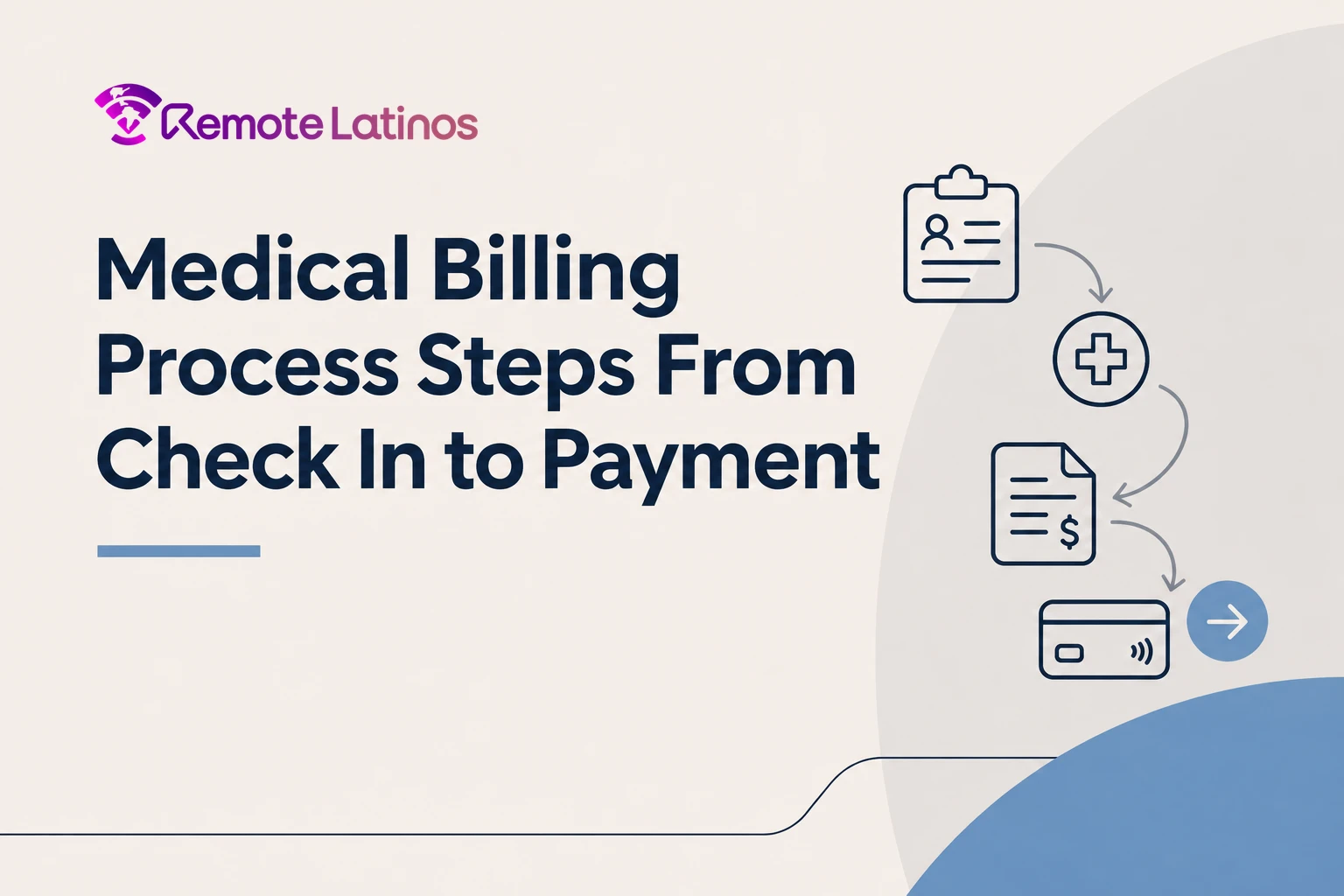
The medical billing process has ten steps: patient registration, insurance verification, check in, coding, charge entry, claim scrubbing, claim submission, adjudication, payment posting, and denial and patient balance follow up. Each step hands its errors to the next one, so most unpaid claims fail long before anyone notices.
A practice manager rarely needs another definition of medical billing. What helps is knowing where each step leaks, who should own it, and which steps a remote biller can take over without touching clinical decisions.
Below, each step comes with its usual failure point and an ownership call: front desk, clinical staff, or a remote billing professional.
Key Takeaways
- Medical billing runs in ten steps, and the first four decide whether the claim gets paid on the first try.
- Medicare requires fee for service claims to be filed within 12 months of the date of service, and commercial plans often set shorter windows in their contracts.
- KFF found that 18% of denied in network marketplace claims in 2023 were denied for administrative reasons, the kind a billing desk can prevent.
- Coding decisions stay tied to clinical documentation. Charge entry, claim follow up, payment posting and patient balance calls are screen based work a remote biller can own.
- Track each claim by age. A claim that sits untouched past 30 days usually has a problem nobody has looked at yet.
What Are the Steps in the Medical Billing Process?
The medical billing process is the sequence of tasks that turns a patient visit into a paid claim and a closed patient balance. It sits inside the wider revenue cycle, which also covers scheduling, authorization and reporting; our guide on what revenue cycle management is for a small practice covers that wider frame.
| Step | What happens | Where it usually leaks | Best owner |
|---|---|---|---|
| 1. Registration | Capture demographics and insurance details | Misspelled names, wrong member ID, outdated address | Front desk or remote intake |
| 2. Insurance verification | Confirm active coverage, benefits and authorization needs | Plan changed since the last visit | Remote verification specialist |
| 3. Check in | Confirm identity, collect copay, update forms | Copay not collected at the counter | Front desk, in the office |
| 4. Coding | Assign diagnosis and procedure codes from the provider's documentation | Codes that do not match the note | Certified coder working from clinical documentation |
| 5. Charge entry | Enter codes, fees and units into the billing system | Missed charges, wrong units | Remote biller |
| 6. Claim scrubbing | Check the claim for errors before it leaves | Edits ignored to save time | Remote biller |
| 7. Submission | Send the claim to the payer, usually through a clearinghouse | Rejections nobody reads | Remote biller |
| 8. Adjudication | The payer reviews and pays, reduces or denies | Payer errors that go unchallenged | Remote biller monitoring status |
| 9. Payment posting | Record payer payments, adjustments and patient responsibility | Underpayments posted as if correct | Remote biller |
| 10. Follow up | Work denials, appeal, and collect patient balances | Denials that age into write offs | Remote accounts receivable specialist |
Steps 1 to 3: Registration, Verification and Check In
The first three steps decide whether the claim can be paid at all. A claim with the wrong member ID or an inactive plan will be rejected no matter how well it is coded.
Registration should capture the patient's legal name exactly as it appears on the insurance card, the member ID, the group number, the subscriber if it is not the patient, and every plan the patient carries. When a patient has two plans, the office has to know which one pays first, because sending the claim to the wrong plan restarts the clock.
Verification happens before the visit, not at the counter. A remote verification specialist can check eligibility through payer portals one or two days ahead, flag visits that need prior authorization, and estimate the patient's share so the front desk can collect it at check in. Our piece on the prior authorization process for small practices covers the authorization part of that work.
Check in is the one step in this group that needs a person in the room. Collecting the copay at the counter is far easier than collecting it by statement three weeks later.
Steps 4 to 6: Coding, Charge Entry and Scrubbing
Coding turns the provider's documentation into the diagnosis and procedure codes the payer uses to decide what to pay. Charge entry loads those codes, with fees and units, into the billing system. Scrubbing checks the finished claim against payer rules before it goes out.
Coding is where clinical and administrative work meet, so it needs a clear rule: codes follow the documentation, never the other way around. If the note does not support a code, the coder asks the provider to amend the note through the proper process. A coder who picks codes to get paid is creating audit risk, not revenue.
Charge entry and scrubbing are pure screen work. The common leak is speed: a biller who clears scrubber edits by overriding them, or who batches charges once a week, sends errors downstream. A daily charge entry habit, with every edit read before it is cleared, prevents a large share of rejections.
Steps 7 to 8: Submission and Adjudication
Submission sends the claim to the payer, almost always electronically through a clearinghouse. Adjudication is the payer's review, which ends in payment, partial payment or denial.
The deadline that matters most here is timely filing. Medicare requires fee for service claims to be filed within 12 months, or one calendar year, after the date of service, and claims filed later are denied (Centers for Medicare and Medicaid Services, 2023). Commercial contracts often set shorter windows, so the billing desk needs each payer's limit written down.
Two different things can come back. A rejection means the clearinghouse or payer refused the claim before processing it, usually for a data error, and it can be corrected and resent. A denial means the payer processed the claim and decided not to pay. Mixing the two up is how practices lose weeks.
Steps 9 to 10: Payment Posting and Follow Up
Payment posting records what the payer paid, what was adjusted under the contract, and what the patient owes. Follow up is the work on everything that did not come back paid in full.
Posting is where underpayments hide. If the biller posts whatever the payer sent without comparing it to the contracted rate, short payments look like normal adjustments and disappear. A quick comparison against the fee schedule on every remittance catches them.
Follow up is where most small practices fall behind. KFF found that HealthCare.gov insurers denied 19% of in network claims in 2023, and that the most common reported reasons were a general other category at 34%, administrative reasons at 18%, and excluded services at 16% (Lo et al., 2025).
Only 6% were denied for lack of medical necessity. The data covers marketplace plans only, but it points to the same lesson: much denial work is paperwork, and paperwork can be worked.
Work aged claims by bucket: under 30 days, 31 to 60, 61 to 90, and over 90. Patient balances need their own cadence of statements, reminder calls and payment plans, which is work a bilingual remote coordinator handles well; our guide on how clinics cut no shows with confirmation and recall workflows uses the same calling rhythm.
Which Steps Can a Remote Biller Own?
A remote biller can own steps 2 and 5 through 10 in full, and support step 1. Step 3 stays in the office, and step 4 belongs to a certified coder working from the provider's documentation, whether that coder sits in the office or not.
When you write the job post for this seat, state the steps as outcomes rather than as a software checklist. Lou Adler notes that companies still lean too heavily on skills and experience to screen candidates, which eliminates qualified people whose mix of experience looks different on paper (Adler, 2022). Clean claim rate and days in accounts receivable describe the job better than a list of clearinghouses.
| Work | In the office | Remote biller | Winner |
|---|---|---|---|
| Copay collection at the counter | Yes | No | In the office |
| Eligibility checks before the visit | Competes with patients at the desk | Done in a quiet block, one or two days ahead | Remote |
| Charge entry and scrubbing | Often batched when the desk is quiet | Done daily as a dedicated task | Remote |
| Payer calls and portal follow up | Interrupted by walk ins and phones | Uninterrupted, during payer business hours | Remote |
| Coding decisions | Depends on who is certified | Depends on who is certified | Whoever holds the certification and reads the note |
Any remote biller handling patient records needs HIPAA safeguards, controlled system access and, where it applies, a business associate agreement; our guide on HIPAA and remote staff covers when that agreement is required. Write down which steps the remote biller owns and which numbers they report each week.
Remote Latinos places vetted billing and administrative professionals from Latin America who work United States hours, and placements commonly run 1,000 to 1,600 USD a month depending on role and experience. Practices can hire a vetted remote medical biller or browse the roles most commonly staffed remotely.
Conclusion
The medical billing process runs in ten steps from registration to follow up, and most failures start in the first four. Verify before the visit, code from the note, read every scrubber edit, post against the contract, and work every claim by age.
Keep the counter and the coding decisions close to the patient and the provider. Hand the screen based steps to someone whose whole day is billing, in the office or remote.
You can also read:
- The Prior Authorization Process Explained for Small Practices
- What Does a Patient Coordinator Do, and Can the Role Be Remote?
See how other practices set up remote billing support in the client testimonials, or book a call to decide which billing steps to hand over first.
Frequently Asked Questions
What are the 10 steps in the medical billing process?
The ten steps are patient registration, insurance verification, check in, coding, charge entry, claim scrubbing, claim submission, payer adjudication, payment posting, and denial and patient balance follow up. The order matters because each step passes its errors to the next.
What are the steps in the medical billing process?
The steps follow the patient from booking to a closed balance: capture the patient and insurance details, verify coverage, check the patient in, code the visit from the provider's documentation, enter and scrub the charges, submit the claim, track the payer's decision, post the payment, and work denials and patient balances until the account is settled.
What is the last step in the medical billing process?
The last step is follow up: working denied or underpaid claims through correction or appeal, and collecting the patient's remaining balance through statements, calls and payment plans. The process ends when the account balance reaches zero or is formally written off.
References
Adler, L. (2022). Hire with your head: Using performance-based hiring to build outstanding diverse teams (4th ed.). Wiley.
Centers for Medicare and Medicaid Services. (2023). Medicare claims processing manual, chapter 1, section 70: time limitations for filing claims.
Lo, J., Long, M., Wallace, R., Salaga, M., and Pestaina, K. (2025, January 27). Claims denials and appeals in ACA marketplace plans in 2023. KFF.