Permanent Establishment Risk Explained for US Companies Hiring Abroad
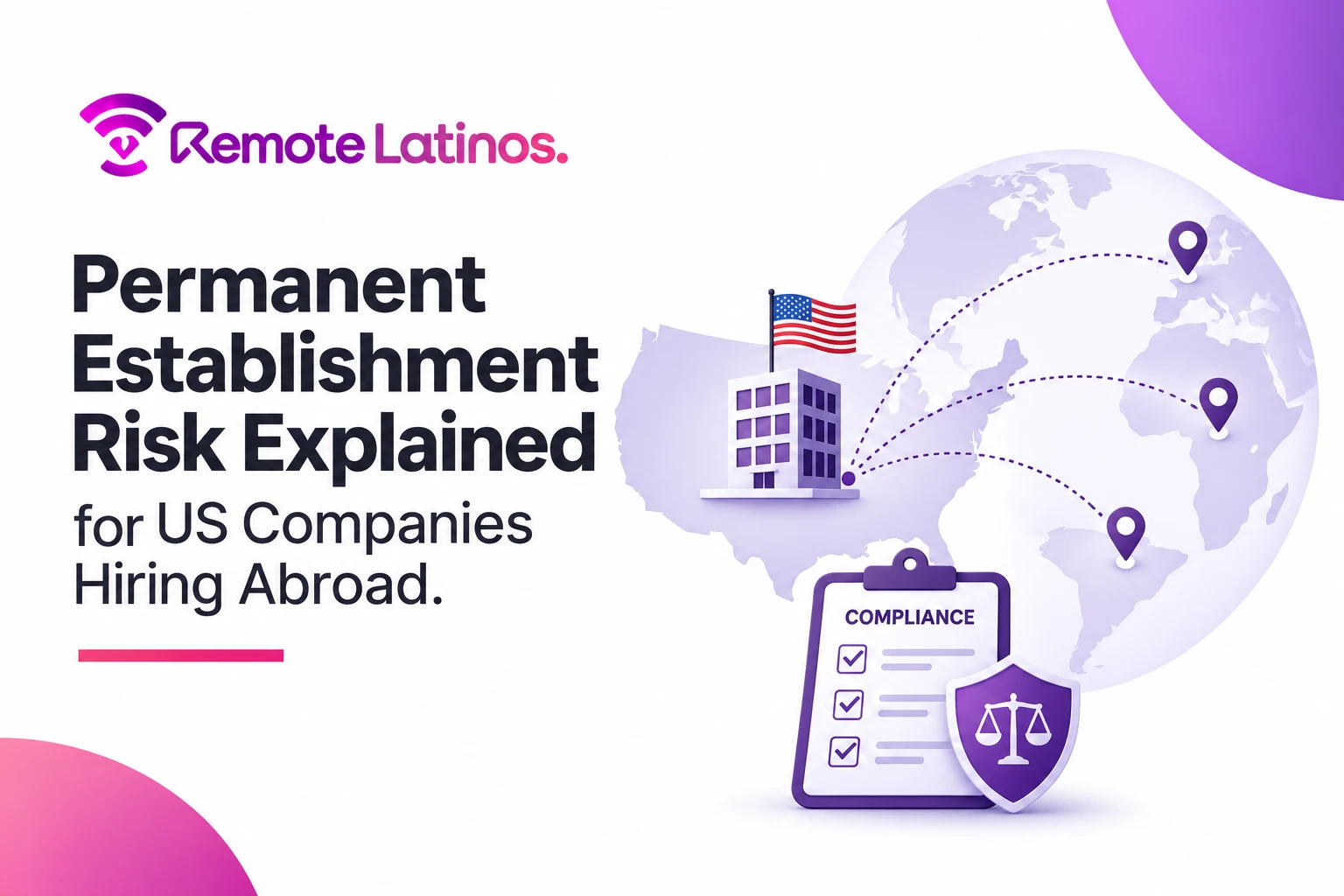
Permanent establishment risk is the chance that hiring or operating in another country gives that country the right to tax your company's profits, even when you have no office, lease or registered entity there (Payoneer, n.d.). For a US company hiring remote talent abroad, the risk turns on what the person actually does and how you engage them. This guide is general information, not tax or legal advice, so confirm your own exposure with a tax advisor for each country where you hire.
Key Takeaways
- Permanent establishment, or PE, is a tax concept that decides whether a foreign country can tax your company; PE risk is the chance your activity there crosses that line and creates back taxes, penalties or double taxation (Payoneer, n.d.).
- It comes in four forms: a fixed place of business such as a home office, a dependent agent who habitually concludes contracts for you, long running construction or project work, and the newer service or digital PE (Remote, n.d.).
- Verdict: the risk is driven by behavior, not geography. A support contractor who does not sign contracts or run core business is low risk; an employee who closes deals or makes senior decisions in country is where exposure builds.
- Cost: getting PE wrong means back taxes, penalties and double taxation in a country you never registered in; engaging the person as a support contractor, or through an employer of record where employment is required, keeps that exposure low (Paychex, n.d.).
What Is Permanent Establishment Risk?
Permanent establishment, usually shortened to PE, is a tax concept that settles one question: whether a country has the right to tax your company's profits there (Payoneer, n.d.). Permanent establishment risk is the chance that your activity in a country crosses that line, so a tax authority treats you as having a taxable presence even though you never registered an entity.
The stakes are concrete. Once a PE exists, you can owe corporate income tax in that country, plus penalties and interest for the years you did not file, and you can face double taxation (Payoneer, n.d.). Hiring across borders used to mean opening an office. Now it can mean one person working from their apartment, which is where the risk hides.
What Triggers Permanent Establishment When You Hire Abroad?
PE risk depends on what the person actually does in the country, not simply that they are there. Tax authorities look at the substance of the activity. Some behaviors raise the risk sharply, others barely move it.
| Behavior of the person abroad | Raises PE risk? | Why |
|---|---|---|
| Habitually concludes or signs contracts for your company | High | Creates a dependent agent PE |
| Negotiates and closes the deals that lead to contracts | High | Core revenue activity in country |
| A senior leader makes core business decisions in country | High | Management function located there |
| Long running, continuous use of a home office for your work | Moderate | May meet the fixed place of business test |
| Performs support work (admin, back office, research) | Lower | Not core revenue or decision making |
| Short term or occasional remote work | Lower | Lacks the permanence tax authorities look for |
The pattern is clear. The risk climbs when the person concludes contracts, creates valuable intellectual property, or performs core business functions abroad (Fieldfisher, n.d.). It stays low when the role is genuine support that does not bind the company or run its core business.
The Four Types of Permanent Establishment
PE comes in four recognized forms, and a remote hire usually raises the first two (Remote, n.d.).
- Fixed place of business. A location at the company's disposal, which can include a home office used continuously for the company's work.
- Dependent agent (agency PE). A person who habitually concludes contracts, or plays the principal role leading to them, on the company's behalf.
- Construction or project PE. A building site or installation project that runs beyond a set duration.
- Service or digital PE. Providing ongoing services in a country, a newer category some jurisdictions apply even without a physical place.
What Did the 2025 OECD Update Change?
On November 19, 2025, the OECD released its 2025 Update to the Model Tax Convention, the first significant change to Article 5 on permanent establishment in nearly a decade. It added a framework for when a home or other place can count as a fixed place of business, including a working time benchmark around 50 percent and a commercial reason test (EY, 2025).
One limit matters for hiring. The update clarified the home office, fixed place of business side, but it did not resolve the dependent agent rules (EY, 2025). So a company cannot lean on the home office test alone, especially for senior people who may sign or negotiate contracts. The agency PE risk has to be managed on its own.
Does a Contractor or an EOR Avoid Permanent Establishment Risk?
There are three ways to engage someone abroad, and they carry different exposure. The honest answer is that no structure is a magic shield; the activity still matters. But the structure changes how much risk you carry.
| Structure | How it affects PE risk | Winner For |
|---|---|---|
| Direct foreign employee | Highest exposure if the person does core or contract work; you also take on local payroll and compliance | Companies ready to register an entity |
| Independent contractor | Lower risk when the person is a genuine contractor in a support role and does not conclude contracts; engaging a contractor does not by itself eliminate PE risk (Paychex, n.d.) | Support roles that do not bind the company |
| Employer of record (EOR) | The EOR is the legal employer in country and handles payroll and local compliance, which reduces exposure, though it does not eliminate all PE risk on its own (Oyster, n.d.) | Hiring employees abroad without your own entity |
The takeaway is that structure and role work together. A support contractor who does not sign contracts is the lowest risk path. Where the work has to be employment, an employer of record carries the local compliance so you do not have to register an entity, while you keep the person out of contract concluding and core decision roles.
How to Hire Abroad Without Creating Permanent Establishment Risk
You lower PE risk by controlling the role and the structure, and by writing both down.
- Scope the role to support. Keep the person in admin, back office or research work, not core revenue or management.
- Withhold contract authority. Do not let a remote hire conclude, sign or negotiate contracts on the company's behalf.
- Pick the structure on purpose. Use a genuine contractor arrangement for support work, or an employer of record where employment is required.
- Set a remote work policy. Require advance approval for where people work and address PE in the policy (Paychex, n.d.).
- Track the facts. Record what each person does, where, and for how long, since PE turns on the activity.
- Get local advice. Confirm the exposure with a tax advisor in each country where you hire.
This is why many US companies hiring in Latin America engage talent as support contractors rather than foreign employees. Remote Latinos places vetted remote professionals from Latin America in support roles that keep the engagement simple. You can build a team of vetted remote professionals, see the roles you can hire, read client testimonials, and book a discovery call.
Conclusion
Permanent establishment risk is not about where someone sits; it is about what they do and how you engage them. The exposure climbs when a person concludes contracts, makes core decisions or runs core business in another country, and it stays low when the role is genuine support.
The 2025 OECD update tightened the home office test but left the dependent agent rules in place, so the role still decides the risk. Keep remote hires in support work, withhold contract authority, choose a contractor or employer of record structure on purpose, and confirm the facts with a tax advisor. Hire that way and you can build an international team without inviting a foreign tax bill.
Frequently Asked Questions
What is permanent establishment risk?
It is the risk that your activity in another country gives that country the right to tax your company's profits, even without an office or registered entity there. Once a permanent establishment exists, you can owe corporate income tax, penalties and interest, and face double taxation (Payoneer, n.d.).
How do you avoid permanent establishment risk?
Keep remote hires in support roles, do not give them authority to conclude or sign contracts, choose a genuine contractor arrangement or an employer of record on purpose, set a remote work policy, track what each person does, and confirm exposure with a tax advisor in each country (Paychex, n.d.).
What can a permanent establishment trigger?
A permanent establishment can trigger corporate income tax in the host country, back taxes with penalties and interest for years you did not file, local payroll and withholding obligations, and double taxation. The exposure is why companies manage PE before hiring abroad (Payoneer, n.d.).
Is permanent establishment risk a concern for US companies?
Yes. A US company can create a permanent establishment abroad through a remote worker who concludes contracts, makes core decisions, or continuously uses a home office for the company's work. The risk is assessed under the host country's rules and any tax treaty, which is why structure and role matter (EY, 2025).
References
Payoneer. (n.d.). Permanent establishment risk: What global employers need to know. Retrieved November 25, 2026, from https://www.payoneer.com/resources/workforce-management/hr-and-compliance/permanent-establishment-risk/
EY. (2025). OECD 2025 update: New rules on permanent establishment for remote work. Retrieved November 25, 2026, from https://www.ey.com/en_ch/technical/tax-alerts/oecd-2025-update-new-rules-on-permanent-establishment-for-remote-work
Paychex. (n.d.). What is permanent establishment risk? Retrieved November 25, 2026, from https://www.paychex.com/glossary/what-is-permanent-establishment-risk
Oyster. (n.d.). Using EOR to manage permanent establishment risk. Retrieved November 25, 2026, from https://www.oysterhr.com/library/employer-of-record-permanent-establishment
Fieldfisher. (n.d.). Global mobility and the risk of accidental permanent establishment. Retrieved November 25, 2026, from https://www.fieldfisher.com/en/insights/global-mobility-and-the-risk-of-accidental-permanent-establishment