Structured Interview Questions That Predict Remote Performance
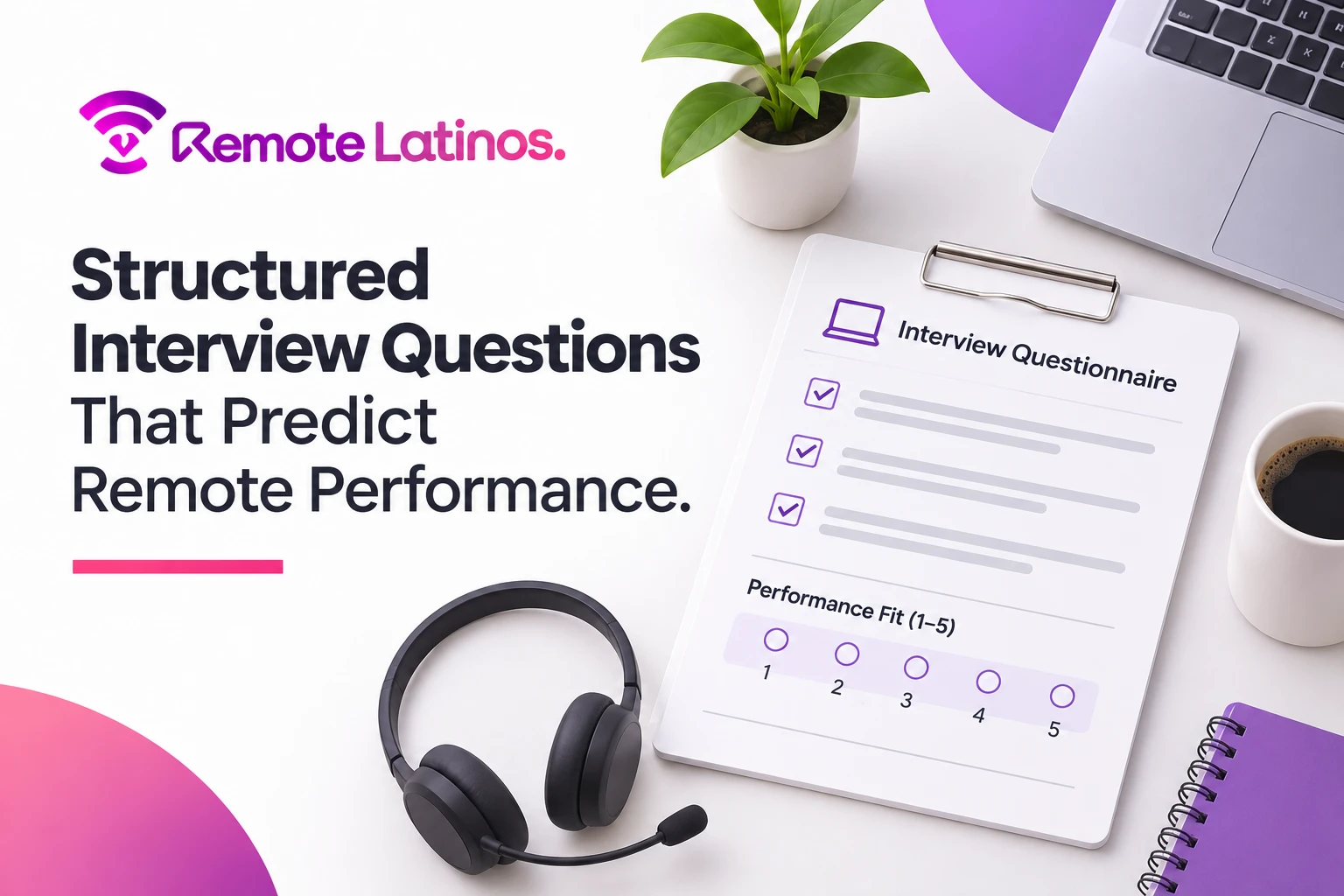
Structured interview questions are a fixed set of job related questions asked of every candidate in the same order, scored against the same rubric. They exist to replace gut feel with evidence, and the research is blunt about why that matters: in the most recent large reanalysis of selection methods, structured interviews were the single strongest predictor of job performance (Sackett et al., 2022). This guide gives you a ready interview cycle, scoring anchors and a clear reject rule, built for remote roles.
Key Takeaways
- A structured interview asks every candidate the same job related questions in the same order and scores the answers against the same anchored rubric, so decisions rest on evidence, not impressions.
- Structure is what makes interviews predictive. Sackett and colleagues (2022) put structured interviews at the top of all selection methods, at about .42 validity versus .19 for unstructured, more than double the predictive power.
- Verdict: define the outcomes first, ask the same questions, score each answer with anchors before anyone discusses the candidate, and reject anyone below the bar on a must have competency.
- Cost: the price of a structured interview is an hour of design; the price of an unstructured one is a mis hire, which is why the structure pays for itself in roles you need to last (Sackett et al., 2022).
What Are Structured Interview Questions?
Structured interview questions are a planned set of job related questions asked of every candidate the same way, then rated on the same scale. The opposite is the unstructured interview, a free flowing chat that changes with each candidate and leans on the interviewer's read of the room.
The difference is not politeness or warmth; a structured interview can feel like a normal conversation. The difference is that the questions are fixed, tied to the real work, and scored with defined anchors, so two interviewers rating the same answer land in nearly the same place.
Why Do Structured Interviews Predict Performance Better?
Structured interviews predict performance better because they remove the noise that unstructured interviews add. Meta analyses have agreed on this for decades, each finding structured interviews more valid than unstructured ones (Oh, Postlethwaite & Schmidt, 2012).
The most recent large reanalysis sharpened the picture. Sackett and colleagues (2022) found structured interviews to be the strongest single predictor of job performance among common selection methods, at roughly .42 validity against .19 for unstructured, more than double the predictive power. An earlier classic summary put structured interviews at .51 and unstructured at .38 (Schmidt & Hunter, 1998). The exact figures move with the method, but the direction never does: structure wins.
Part of the reason is bias. In unstructured interviews, interviewers tend to decide early and then look for support, letting first impressions color the rest (McDaniel et al., 1994). Fixed questions and anchored scoring hold that off until the evidence is in.
How to Build a Structured Interview, Step by Step
A structured interview is built, not improvised. The work happens before the candidate ever joins the call.
- Define the outcomes first. Write a scorecard: the outcomes and competencies that define the role done well, not a generic job description (Smart & Street, 2008).
- Pick the competencies to test. Choose the four to six competencies that actually predict success in the role, and mark which are must haves.
- Write one question set. Draft job related questions that gather facts about each competency, and ask them of every candidate in the same order.
- Anchor the scoring. For each question, define what a weak, average and strong answer looks like on a simple scale.
- Interview for real work. Favor questions about accomplishments comparable to the job's actual work, the heart of performance based hiring (Adler, 2021).
- Score independently. Each interviewer rates before the panel talks, so no one anchors on the loudest voice in the debrief.
Skills are the easy part to test; attitude and self management are harder to see and often decide who succeeds, so build questions that surface them rather than hoping they show up (Murphy, 2012).
Structured Interview Questions That Predict Remote Performance
Remote roles add competencies that an office hides: self direction, written communication and the discipline to work across time zones without a manager in the room. Ask the same questions of every candidate, and ask for specific past examples, not opinions. Treat these as a starting set to adapt to your scorecard.
Self management and ownership
- Tell me about a time you had to finish a project with no one checking your progress. How did you keep it on track?
- Describe the last week you worked. Walk me through how you decided what to do each day.
- Give an example of a deadline you were going to miss. What did you do before it slipped?
Written communication
- Tell me about a time a written message you sent was misread. What happened, and what did you change?
- Walk me through how you would hand off a task to a teammate in another time zone who is offline when you finish.
Async collaboration and judgment
- Describe a time you were blocked and your manager was asleep in another time zone. What did you do?
- Give an example of a decision you made on your own that you could have escalated. How did you decide to act?
Every one of these asks for a real example, because past behavior on comparable work is the signal. Vague answers that stay in the abstract are themselves data.
How to Score Answers and When to Reject
Scoring is where structure earns its keep. Rate each answer on a simple anchored scale, write the score before the debrief, and compare against the scorecard, not against the other candidates in the room.
| Score | Label | What the answer shows |
|---|---|---|
| 1 | Below bar | No real example, or an example that shows the opposite of the competency |
| 2 | Developing | A relevant example, but thin on ownership, result or detail |
| 3 | Meets | A specific example with a clear action and a reasonable result |
| 4 | Strong | A specific example with ownership, a measurable result and good judgment |
| 5 | Exceptional | A hard example handled with clear ownership and a result well above expectation |
Then apply one reject rule and hold it. Reject any candidate who scores below your bar on a must have competency, no matter how strong they look elsewhere. A great communicator who cannot work without supervision will not survive a remote role, and the score, not the charm, is what you act on.
Structured vs Semi-Structured vs Unstructured: Which to Use?
There are three ways to run the interview, and they trade consistency for flexibility.
| Interview type | How it works | Winner For |
|---|---|---|
| Structured | Same questions, same order, anchored scoring for every candidate | Predictive, fair hiring at any volume |
| Semi-structured | A fixed core of scored questions, plus room for follow ups to probe deeper | Senior or complex roles that need judgment calls |
| Unstructured | A free conversation that changes with each candidate, scored on impression | Little; it is the least predictive of the three |
Semi-structured interviews keep the scored core but allow follow up questions, which is why many teams use them for senior roles. Pure unstructured interviews are the weakest and the most biased, and they are the habit most worth breaking (Smart & Street, 2008).
How to Run Structured Interviews for Remote Hires
Put the method to work the same way every time, and the quality of your remote hires stops depending on who happened to run the call.
- Build the scorecard per role. List the outcomes and the four to six competencies, remote ones included.
- Lock the question set. Write the questions once and ask them of every candidate in the same order.
- Record or note every answer. Capture what was said so the score rests on evidence, not memory.
- Score before you debrief. Each interviewer rates independently, then the panel compares.
- Hold the reject rule. Below the bar on a must have competency means no, every time.
- Review your hits and misses. Check how your scores lined up with real performance and tune the questions.
This is the same discipline behind avoiding common hiring mistakes and running a cleaner hiring process. Remote Latinos screens Latin American talent with structured interviews and recorded answers, so you see evidence before you ever meet a candidate. You can build a team of vetted remote professionals, read client testimonials, and book a discovery call.
Conclusion
Structured interview questions work because they test the same job related things in the same way and score them against a standard. That is what makes them the strongest single predictor of performance among selection methods, far ahead of the unstructured chat most teams still run on intuition.
For remote roles the payoff is larger, because self management and written communication do not show up in a casual conversation; you have to ask for them and score them. Define the outcomes, ask every candidate the same questions, score with anchors before you debrief, and hold the reject rule. Do that, and your remote hires start to predict out.
Frequently Asked Questions
What are structured interview questions?
They are a fixed set of job related questions asked of every candidate in the same order and scored against the same anchored rubric. The consistency is what makes them predictive, and structured interviews rank as the strongest single predictor of job performance among selection methods (Sackett et al., 2022).
How do you develop structured interview questions?
Start with a scorecard of the outcomes and competencies the role needs, pick the four to six that predict success, write job related questions that gather facts about each, and define anchored scores for weak, average and strong answers. Favor questions about accomplishments comparable to the real work (Adler, 2021; Smart & Street, 2008).
What are good structured interview questions?
Good questions ask for specific past examples tied to the role, such as finishing a project with no supervision, handling a message that was misread, or acting when a manager was offline in another time zone. They avoid hypotheticals and opinions, because past behavior on comparable work is the signal.
What are semi-structured interview questions?
Semi-structured interviews keep a fixed core of scored questions asked of everyone, then allow planned follow up questions to probe deeper. They trade a little consistency for flexibility, which is why teams often use them for senior or complex roles while keeping the scored core intact.
References
Sackett, P. R., Zhang, C., Berry, C. M., & Lievens, F. (2022). Revisiting meta-analytic estimates of validity in personnel selection: Addressing systematic overcorrection for restriction of range. Journal of Applied Psychology, 107(11), 2040-2068.
Schmidt, F. L., & Hunter, J. E. (1998). The validity and utility of selection methods in personnel psychology. Psychological Bulletin, 124(2), 262-274.
Oh, I.-S., Postlethwaite, B. E., & Schmidt, F. L. (2012). Rethinking the validity of interviews for employment decision making. In Research in personnel and human resources management.
Smart, G., & Street, R. (2008). Who: The A method for hiring. Ballantine Books.
Adler, L. (2021). Hire with your head (4th ed.). Wiley.
Murphy, M. (2012). Hiring for attitude. McGraw-Hill.