What Does a Loan Processor Do and Where Remote Support Fits
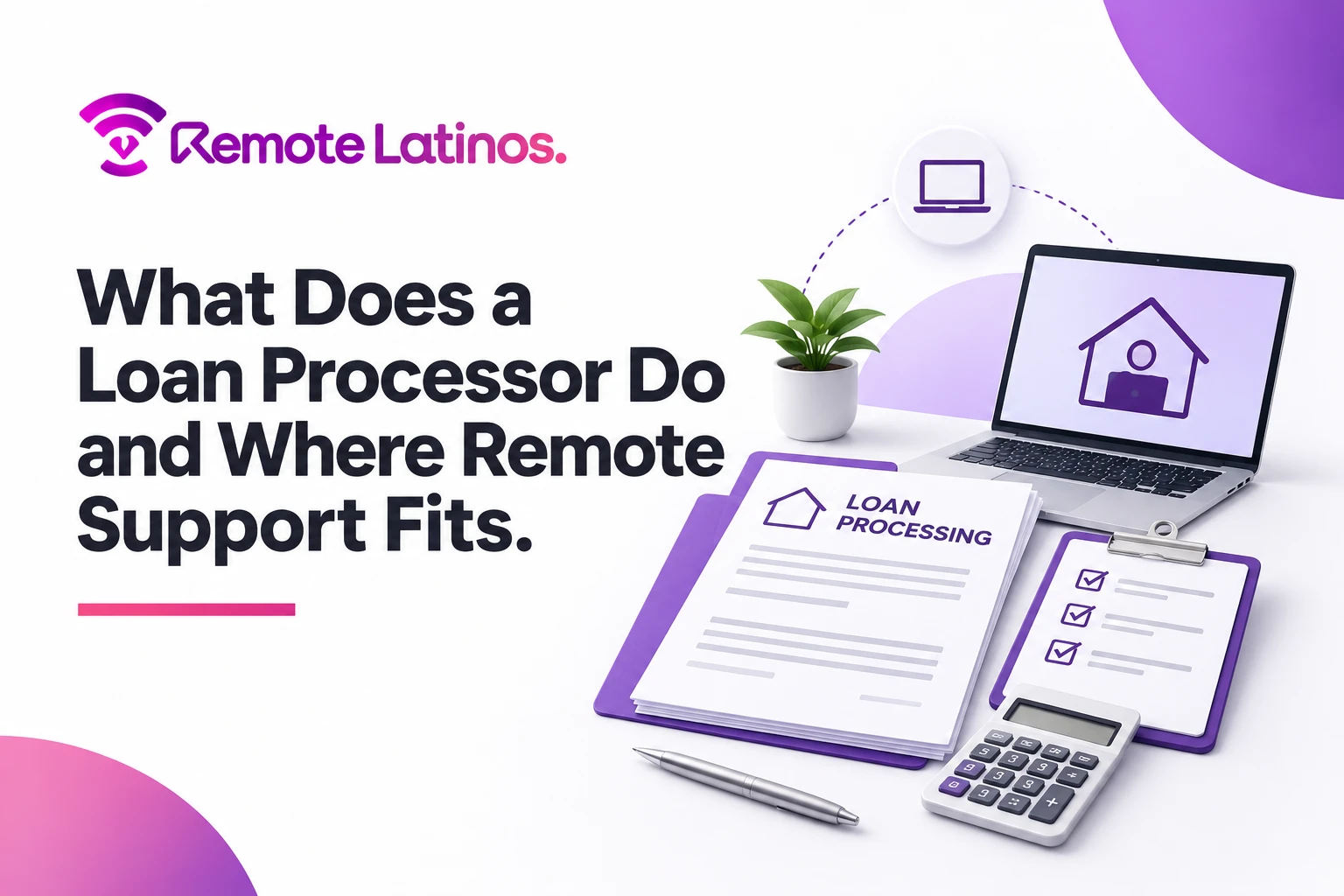
A loan processor assembles and verifies a borrower's mortgage file and moves it from application to clear to close, working under a licensed loan originator. The processor does not set or negotiate loan terms. Most of the job is document collection, ordering third party services and follow up, which is where a trained remote assistant can carry the file forward without crossing into licensed activity.
Key Takeaways
- A loan processor collects, organizes and verifies the documents in a mortgage file and prepares it for underwriting, performing clerical and support duties under the supervision of a licensed loan originator (12 CFR Part 1008).
- The line is drawn in federal rules: clerical and support work needs no license, but offering or negotiating rates or terms, or counseling a borrower, is loan originator activity that requires an NMLS license (12 CFR Part 1008, Appendix C).
- Verdict: put the clerical file work (document collection, ordering services, stacking the file, status updates, chasing conditions) on a remote assistant, and keep applications, terms and advice with your licensed staff.
- Cost: a US loan processor, classed as a loan interviewer and clerk, earns a median of about $50,020 a year (BLS, 2025), while a remote processing assistant in Latin America typically runs $800 to $1,200 a month in base pay.
What Is a Loan Processor?
A loan processor is the person who takes a mortgage application after it is submitted and turns it into a complete, verified file an underwriter can decide on. Under federal rules, a loan processor performs clerical or support duties at the direction of and under the supervision of a licensed or registered loan originator (12 CFR Part 1008).
The processor sits between the loan officer, who takes the application and owns the borrower relationship, and the underwriter, who approves, denies or sets conditions. The processor's job is to make the file complete and accurate so the decision comes back fast and clean. For a related outside hiring comparison, see this guide to what nearshore staffing is.
What Does a Loan Processor Do, Step by Step?
A processor runs every file through the same sequence, whatever the loan type.
- Review the application. Check the 1003 for completeness and flag gaps before the file moves forward.
- Order third party services. Request the appraisal, title, credit supplement, flood certificate and any payoffs.
- Collect and verify documents. Gather pay stubs, W2s, bank statements, tax returns and IDs, and confirm employment and deposits.
- Build the file. Stack and label the documents the way the underwriter and the investor expect to see them.
- Submit to underwriting. Hand over a complete file and track the decision.
- Clear conditions. Chase the documents that satisfy each underwriting condition until the file reaches clear to close.
A processor who performs these clerical and support duties under a licensed originator needs no license of their own (12 CFR Part 1008).
How Long Does Processing Take?
Most of a loan's timeline is processing and verification, not the final signing. The average purchase loan closed in 36.8 days in March 2026, the fastest pace on record since ICE began tracking the metric in 2019 (ICE Mortgage Technology, 2026). Underwriting and appraisal are the two phases where days are lost or saved, and both depend on a clean file.
Loan Processor vs Loan Officer vs Underwriter: Who Does What?
These three roles move the same file but carry different authority and licensing. The loan officer owns the borrower and the terms, the processor builds the file, and the underwriter decides.
| Role | What they do | License needed | Sets borrower terms? |
|---|---|---|---|
| Loan officer (loan originator) | Takes the application, offers and negotiates rates and terms, advises the borrower | NMLS loan originator license | Yes |
| Loan processor | Collects, verifies and assembles the file under supervision | No license for clerical and support duties | No |
| Underwriter | Reviews the file and approves, denies or conditions the loan | No MLO license for supervised clerical and support work | No, decides approval, not borrower terms |
Where Does Remote Support Fit, and Where Is the Line?
A remote assistant fits on the clerical side of the file: collection, verification and follow up. The assistant stops at anything that offers or negotiates terms or advises the borrower. Federal rules draw that line directly. A person who performs only clerical or support duties, and does not offer or negotiate loan rates or terms or counsel borrowers, is not required to hold a loan originator license (12 CFR Part 1008, Appendix C).
The supervision condition is what keeps the exemption in place. It holds when a licensed originator assigns, authorizes and monitors the support work (12 CFR Part 1008, Appendix C). So a remote assistant works the file under your licensed officer's direction, never as an independent decision maker.
The cleanest way to set this up is to start with the work, not the job title. Define which tasks on the file are clerical and which need a license, then assign the clerical tasks to remote support and keep the licensed work in house (Tulgan, 2002).
Which Loan Processing Tasks Can a Remote Assistant Own?
The safe set is every task that moves documents and data without touching terms or advice.
| Task in the loan file | Remote assistant | Who owns it |
|---|---|---|
| Collect and chase borrower documents | Yes | Remote assistant |
| Order appraisal, title, payoffs and verifications | Yes | Remote assistant |
| Stack and label the file for underwriting | Yes | Remote assistant |
| Send status updates to the borrower and agent | Yes | Remote assistant, with no advice on terms |
| Track and chase underwriting conditions | Yes | Remote assistant |
| Take the loan application (1003) | No | Licensed loan officer |
| Offer or negotiate rates or terms | No | Licensed loan officer |
| Counsel the borrower on which loan to choose | No | Licensed loan officer |
| Make the credit decision | No | Underwriter or lender |
What Does a Faster File Save You?
A file that moves without gaps closes faster, and a faster close means more funded loans per month for a broker or investor. Location changes the cost of that support more than any software does. A customer facing processing seat is a clear place to compare.
| Cost factor | United States | Latin America |
|---|---|---|
| Pay for processing support | About $50,020 median a year, roughly $24 an hour (BLS, 2025) | $800 to $1,200 a month in base pay, about $9,600 to $14,400 a year (Remote Latinos placement ranges) |
| Licensed work | Stays with your licensed loan officer | Same, the remote assistant handles clerical work only |
| Time zone | Local | Colombia runs on Eastern or Central time depending on the season |
The BLS figure is what the worker earns, not what the employer spends. Benefits, payroll taxes and overhead sit on top of it. For the model behind nearshore hiring, see this guide to the top Latin American countries for remote talent and these top roles to hire for remote teams.
How to Add Remote Support Without Compliance Risk
Keep the remote assistant inside the clerical lane with written scope and real supervision.
- Write the scope. List the clerical tasks the assistant owns and the licensed tasks they never touch.
- Name a supervisor. A licensed originator assigns and monitors the work, which is exactly what the exemption requires (12 CFR Part 1008).
- Control data access. Give access only to the documents the file needs, with secure handling of borrower information.
- Document the process. A written processing checklist lets the assistant run every file the same way.
- Review on a cadence. Check the pipeline for stuck conditions and aging files so nothing sits.
Remote Latinos places vetted remote professionals from Latin America who can run this clerical file work in your time zone. You can build a team of vetted remote professionals, read these client testimonials first, and book a discovery call to map the role to your pipeline.
Conclusion
A loan processor builds and verifies the mortgage file and moves it to clear to close, under a licensed originator and without setting terms. That split is what makes the role safe to support remotely: the clerical file work can sit with a trained remote assistant, while applications, terms and advice stay with your licensed staff.
For a broker, lender or investor who wants to close faster without adding another licensed seat, that is where remote support pays off. Define the clerical work, supervise it, and let a remote assistant keep the file moving.
Frequently Asked Questions
What does a mortgage loan processor do?
A mortgage loan processor collects and verifies a borrower's documents, orders the appraisal, title and verifications, assembles the file to the underwriter's standard, and chases the conditions needed to reach clear to close. The processor works under a licensed loan originator and does not set or negotiate loan terms (12 CFR Part 1008).
What does a loan officer do?
A loan officer, also called a loan originator, takes the application, offers and negotiates rates and terms, and advises the borrower on loan options. These activities require an NMLS loan originator license, which is why they stay with licensed staff and not with clerical support.
What does a loan underwriter do?
A loan underwriter reviews the completed file, assesses the borrower's credit, income, assets and the collateral, and approves, denies or sets conditions on the loan. The underwriter decides whether the loan meets the lender's and investor's rules, not the borrower's rate or terms.
What does a commercial loan processor do?
A commercial loan processor runs the same file building and verification work for business and investment property loans rather than consumer home loans. The documents differ, such as rent rolls, operating statements and entity paperwork, but the role is still clerical support that prepares the file for a credit decision.
References
Consumer Financial Protection Bureau. (n.d.). 12 CFR Part 1008, S.A.F.E. Mortgage Licensing Act (Regulation H). Retrieved November 25, 2026, from https://www.ecfr.gov/current/title-12/chapter-X/part-1008
ICE Mortgage Technology. (2026). ICE Mortgage Monitor report, March 2026. https://mortgagetech.ice.com/resources/data-reports/march-2026-mortgage-monitor
U.S. Bureau of Labor Statistics. (2025). Loan interviewers and clerks (43-4131). Occupational Employment and Wage Statistics. https://www.bls.gov/oes/current/oes434131.htm
Tulgan, B. (2002). Winning the talent wars. W. W. Norton & Company.